Translated from German. We write our content in German.Show original
Namibia packing list for self-drivers, camping and safari

By Laura & Tobi ·
So you definitely don’t forget anything: find out which equipment, clothing and documents you really need to have with you as a self-driver.
On our comprehensive Namibia packing list you’ll find everything you need for your trip to Namibia. This packing list is just right for you if you…
- are travelling through Namibia with a 4x4 and roof tent.
- are on the road as a self-driver with a hire car.
- are looking for a tried-and-tested Namibia packing list specifically for your travel time or season.
- need recommendations for clothing, a travel first aid kit, and outdoor and technical equipment.
Our Namibia packing list is divided into sections to give you a quick and easy overview. Let’s get started!
Clothing for the Namibia packing list
Here you’ll find a packing list with the clothing that we always take to Namibia. We’ve divided this section into four parts for you:
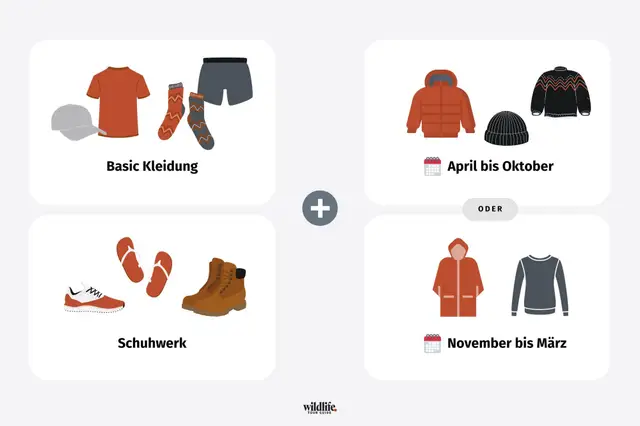
- Basic packing list for clothing: We always take these items to Namibia, regardless of the time of year.
- Footwear for Namibia: As well as clothing you should also have suitable footwear. This list shows you what we always take with us.
- Packing list for the dry season: If you’re travelling to Namibia between May and October, then this Namibia packing list is just right for you.
- Packing list for the rainy season: If you’re travelling between November and April, then make sure you take a look at this packing list.
Basic packing list for clothing
What you would normally put on your Namibia packing list is something you probably know better than we do. So we just want to recommend clothing that we specifically take to Namibia.
You should bear the following in mind when choosing:
- Lightweight clothing: It is usually warm during the day in Namibia, so you should take rather light clothing. Pack light, breathable functional clothing that you can wash and dry quickly.
- Thicker fabrics: There is malaria in Namibia, so in the evenings you should wear long clothing made of thicker fabric. Avoid black clothing as it attracts mosquitoes.
- Choose natural tones: You don’t need special safari clothing. Choose natural tones so that you blend in better with your surroundings.
If your wardrobe isn’t yet geared towards Namibia, we’ve picked out a few items of clothing that feature on our Namibia packing list.
Our product recommendations for you:
- Long-sleeved shirt for the evening, e.g. Craghoppers (men)* or Craghoppers (women)* made of thick fabric.
- Long trousers for the evening, e.g. Fjallraven Karl (men)* with zip-off legs and for women the Fjallraven Karla (women)* or leggings that you impregnate.
- Lightweight long-sleeved shirt, e.g. Patagonia Cap Cool (men)* or Patagonia Cap Cool (women)*.
Footwear for Namibia
For choosing the right shoes in Namibia we’ve also put together some recommendations that are on our Namibia packing list.
You should have the following with you:
- Sturdy shoes: During the day and in the evening sturdy shoes are essential to protect you from thorns and creepy-crawlies. In the evenings they offer extra protection from scorpions, as sturdy shoes protect you very effectively from bites and stings.
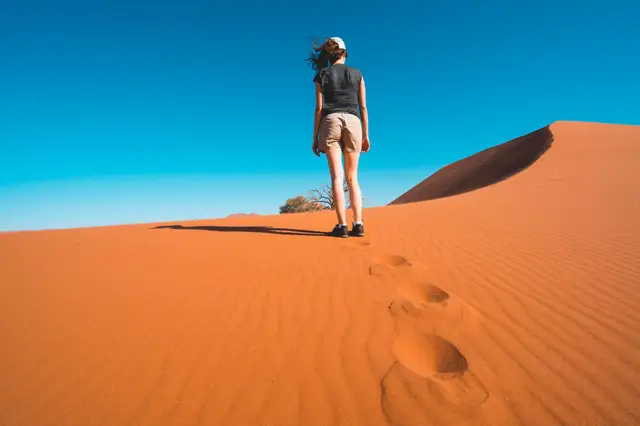
- Flip flops: During the day on the campsite or when showering we usually wear flip flops. In the evenings we change into sturdy shoes. You should also switch to sturdy shoes if you want to hike at Waterberg or climb the dunes at Sossusvlei.
Our product recommendations for you:
- Sturdy shoes: We use the LOWA Renegade GTX (men)* and LOWA Renegade GTX (women)* and are very happy with them. They also come with a higher shaft (men*/women*) if you prefer that.
Specific Namibia packing list for the dry season
If you are travelling to Namibia between May and October it can get really cold. While temperatures are pleasantly warm during the day, at night they can drop to 0–5 degrees. Here are the most important things for your Namibia packing list during the dry season.
You should have the following with you:
- Hat for the night: Despite the warm daytime weather it can get very cold in the tent.
- Warm clothing: It gets chilly in the mornings and evenings. Pack jumpers and jogging bottoms.
- Insulating jacket: A light but warm jacket is essential, especially if you want to get up early to watch animals.
Our product recommendations for you:
- Jacket with small pack size: We use the Patagonia Micro Puff (men)* and Patagonia Micro Puff (women)*
Specific Namibia packing list for the rainy season
Compared with the dry season it never gets particularly cold in the rainy season between November and April. The nights are pleasant, but it can get very hot during the day. Here are our tips for this period for your Namibia packing list.
You should have the following with you:
- Rain jacket: It usually rains briefly and heavily. A rain jacket protects you when you’re stowing away your camping gear.
- Warm jacket: It can be chilly on the coast (Lüderitz or Swakopmund). A wind-resistant all-round jacket is ideal.
Our product recommendations for you:
- Jacket with small pack size: We have the Patagonia Micro Puff (men)* and Patagonia Micro Puff (women)*.
- Rain jacket: We also have this from Patagonia and are very satisfied. We use the Patagonia Torrentshell (men)* and Patagonia Torrentshell (women)*.
Medication and hygiene for the Namibia packing list
In this section we’ve put together important medication and hygiene items that you shouldn’t be without on any trip to Namibia. This packing list helps you to be well prepared.
Medication for a trip to Namibia
Besides the usual medication that you might need regularly, we recommend putting together a small travel first aid kit for Namibia. Here are a few extra things that we always take with us.
You should have the following with you:
- Charcoal tablets and Imodium: On one trip to Namibia we were hit really hard. We had to vomit every 5 minutes. What exactly caused it? We don’t know. Since then we always take something for nausea and diarrhoea with us. The two tend to come together...
- First aid kit: Not all vehicle rental companies have a kit in the car. On our first trip we drove past a moped rider who had had an accident. Luckily, there was already enough help on site. If we had been the first to arrive, though, we wouldn’t have known where the kit with gloves was stored in the vehicle. Since then our own first aid kit always goes between the driver’s and passenger seat.
- Mosquito repellent: As there is malaria in Namibia, you should take a mosquito repellent with a high DEET content and ideally also treat your long clothing for the evenings.
Our product recommendation for you:
- NOBITE mosquito repellent: As mosquito protection we use NOBITE skin spray* and NOBITE clothing spray*.
- First aid kit: We went for an inexpensive but still complete kit. You can, for example, use this one: First Aid Kit*.
Hygiene when camping in Namibia
In addition to the usual hygiene items such as shower gel, shampoo, deodorant, toothpaste, toothbrush, sun cream and tissues, there are a few specific products that are particularly practical for Namibia.
This is what you should take:
- Microfibre towels: These dry quickly and don’t start to smell so easily, which makes them ideal for camping.
- Special shower gel/shampoo: Namibia doesn’t have a wastewater system like we do at home. So use products that are less harmful to nature.
Our product recommendation for you:
- Microfibre towels: We use these very practical microfibre towels*.
- Shower products: The Sea to Summit Wilderness Wash products are environmentally friendly and very economical as they are concentrated. This Sea to Summit Wilderness Wash* works well for hair and body.
Outdoor packing list for Namibia
Camping with a roof tent is very common in Namibia. Good, well thought-out preparation is essential so you are ready for all situations. Here are the pieces of equipment that shouldn’t be missing from any Namibia packing list.
Overnight
Depending on your vehicle’s camping equipment, you should think about a suitable sleeping bag. In the rainy season a summer sleeping bag is enough, while in the dry season you need a warmer sleeping bag. An inflatable pillow saves space in your luggage.
- Sleeping bag* for the dry season
- Sleeping bag liner*: Protects the sleeping bag from sweat and adds extra warmth
- Pillow*
Lighting for camping
Good lighting is essential. Head torches are particularly practical because you have both hands free. Torches and camp lights are also useful for general lighting and emergencies.
This is what you should take:
- Head torch*
- Torch* (we searched for a long time for the perfect camping torch; this one can be charged via USB)
- Camp light*
- Batteries and rechargeable batteries
Doing laundry when camping
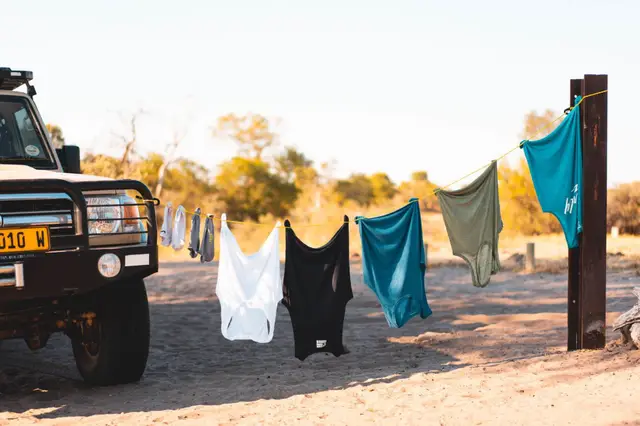
For laundry during your trip it’s helpful to take a washing line and a versatile cleaning product with you.
This is what you should take:
- Washing line*: can be used without pegs
- Wilderness Wash*: an all-in-one product for laundry detergent, washing-up liquid, shower gel and shampoo
Drinks
Sufficient water bottles and a flask are also part of the Namibia packing list.
This is what you should take:
Wildlife watching in Namibia
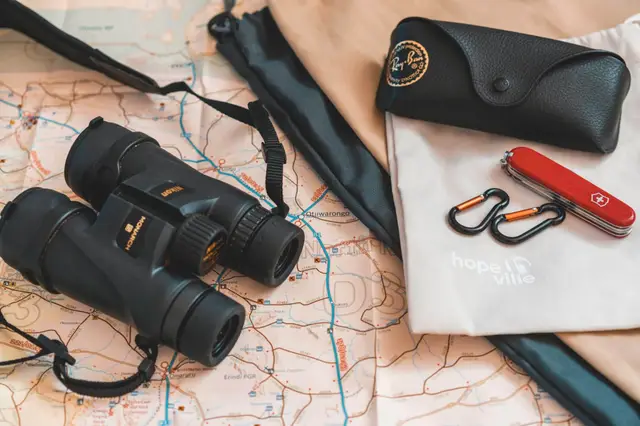
On safaris in Namibia’s national parks a good pair of binoculars is indispensable. Make sure they are light and bright enough to allow for long periods of observation.
This is what you should take:
- Travel guide with wildlife watching tips (including Etosha waterhole map)
- Bright binoculars*
Books and maps for the packing list
Offline maps and travel guides are useful, as you won’t have mobile reception everywhere.
- Namibia travel guide (including app, so you have all activities with you offline)
- Namibia map*
- Offline map material (Google Maps offline maps: navigation even without mobile reception)
- Travel diary / pad for notes
- Book or e-book reader*
Tools for camping in the bush
Strong tape should never be missing from our self-drive Namibia packing list. We had to repair our roof tent in two different places during our trip using tape. A fabric tape that can be torn by hand was super practical for this. You can also use it to repair other things quickly and easily.
Since a small incident we always carry a few karabiners. Once, in the dunes of Sossusvlei, we lost our car keys. They simply slipped out of a trouser pocket. In the biggest sandpit in the world – oh dear. Since that experience our car keys always go on a karabiner hooked to a trouser pocket.
This is what you should take:
- Fabric tape*
- 2–3 karabiners*
- Penknife*
- Pens
Technical equipment for the Namibia packing list
In this section you’ll find all the important information on camera equipment and power supply that shouldn’t be missing from your Namibia packing list.
Camera equipment for Namibia
- Camera
- Lenses
- Batteries and charger
- Memory cards
- Cleaning brush* and blower* for lenses
Power supply when camping
As not every campsite has an electricity connection, it’s important to ensure you have enough power while you’re on the road. Chargers and power banks are essential.
- Power bank*
- Car USB charger*
- Car 230 V charger*
- Multi-socket extension*: so you can charge several devices at the same time
- Travel adapter*
- Charging cables for your mobile phone and other devices
Important: For safety reasons you should definitely carry a power bank in your hand luggage. We didn’t know this and our power bank was taken out during the security check at the airport. Our piece of luggage then only arrived in Windhoek a day later.
Documents and paperwork for the Namibia packing list
Here you’ll find all the important documents and paperwork that you absolutely must not forget at home. These definitely belong on your Namibia packing list.
Passport
If you want to enter Namibia with a German passport, you’ll need a valid passport that is still valid for at least six months beyond your trip. So check your passport in good time so you can apply for a new one if necessary.
Driving licence
So that you can hire and drive a car in Namibia, you must take your national driving licence and an international driving licence with you. The international driving licence is only valid together with the national one. So take both driving licences with you.
Credit card and cash
It’s useful to have both a VISA and a Mastercard with you. The VISA card is more frequently accepted at cash machines. In the article Gebühren für Geldabheben im Ausland sparen we’ve included some more tips for you.
Folder with copies of documents
Just in case, we recommend making copies of all travel documents and keeping them together in a folder. In addition, we scan the documents with our mobile phone and save the files in the cloud or email them to ourselves. That way we always have access to the copies in an emergency.
These documents are on our Namibia camping packing list:
- Passport
- Driving licence and international driving licence
- Credit cards
- Cash in EUR
- Important phone numbers and addresses (overseas health insurance, credit card blocking service, contact person at home)
- Booking documents
Travel bag, backpack or suitcase for camping?
For a camping trip through Namibia, a travel bag or a backpack is more practical than a suitcase. They are easier to stow in the vehicle because they are more flexible and take up less space.
We prefer two roomy travel bags because they have practical openings and are easy to access. You can also use a backpack, but all the straps and buckles can sometimes be a bit of a nuisance.
To organise our luggage in the travel bags, we use packing cubes in different sizes and colours. We pack our clothes in the larger bags and all the small bits and pieces in the smaller ones. That way everything stays tidy and easy to find.
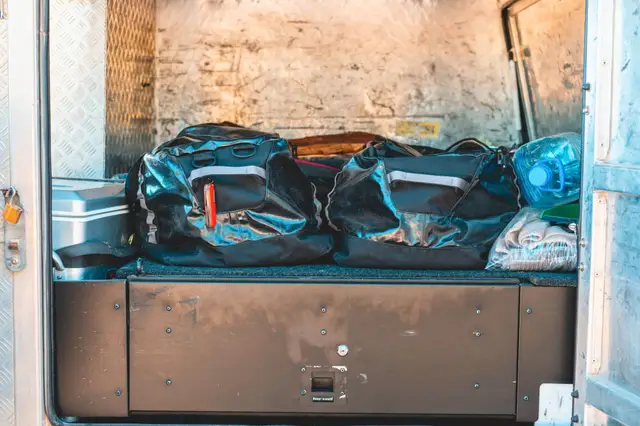
These are all the things that have proven themselves on our trips and therefore belong on every Namibia self-drive packing list. Are you still missing something on our Namibia packing list? Then feel free to write it in the comments.
Plan your trip in the app.
Save activities and places to stay, put your route together and take everything with you offline.