Cette page n’existe pas encore en français : nous te montrons la version disponible.
Surviving in the fog desert

Par Laura & Tobi ·
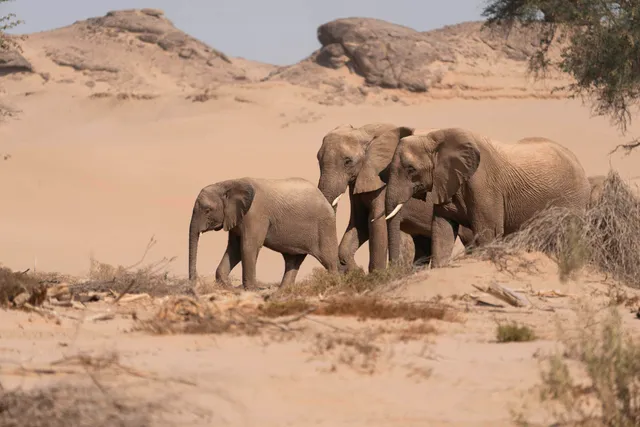
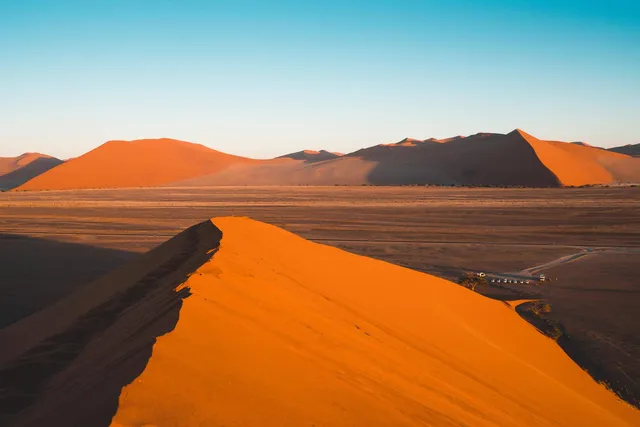
The Namib seems like a hostile place – if you want to survive in the desert, you need some very special strategies.
The Namib is one of the hottest and driest regions in the world. In the desert there is hardly any shade and years of drought. When it does rain every few years, there is usually only enough falling on each square metre to fill a shot glass. But how do animals still manage to survive in this merciless place?
Where fog deserts are found in the world
The Namib is what is known as a fog desert and therefore quite rare on our beautiful planet. There is only the Atacama Desert between Chile and Peru, Baja California on the Mexican peninsula of Lower California and, of course, the Namib Desert in Namibia. For such a special desert to form in the first place, several conditions have to come together in a fascinating way. Are you ready for a bit of meteorology?
The meteorological wonder of the Namib
Off the coast of the Namib, trade winds displace the surface water of the Atlantic and in doing so cause cold deep water to rise. Low-pressure areas in this region then ensure that the warm air off Namibia can absorb the moisture from the cool deep water.
The warm, moist air is carried upwards and cools at higher altitudes, turning into clouds. These are then blown over the Namib Desert and carried up to 100 kilometres inland.
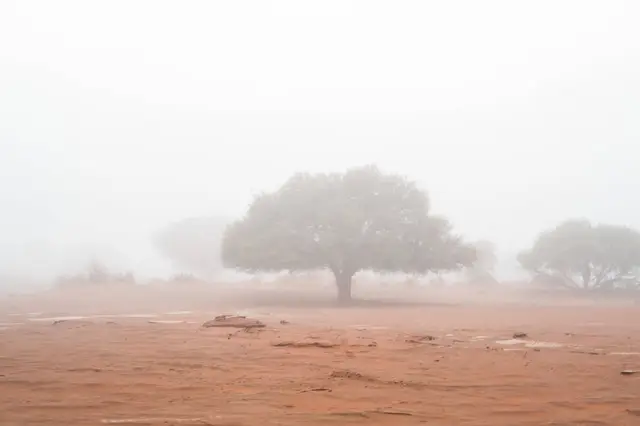
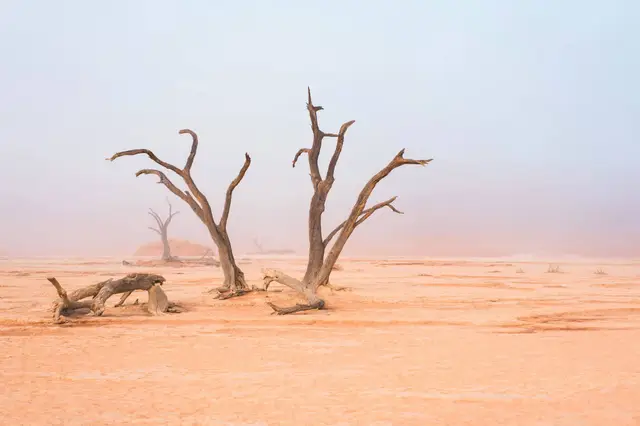
When the clouds touch the ground, fog forms over the desert on many days of the year. It looks eerily beautiful and mystical at the same time when the veils of fog hang between the sand dunes.
Life-giving fog
The fog not only creates this incredible sight in the dry desert, it is also vital for around 50 animal species, as they depend on it. This very interaction is nowhere else in the world’s fog deserts as well researched as it is here in the Namib.
Today we know that all water sources can be traced back to fog, directly or indirectly. An incredible 92% of all precipitation occurs as depositing fog. It rains on so few days of the year that rainwater is not a reliable water source for the animals.
The incredible adaptability of the fog-basking beetle
The best-known and best-researched are the so-called fog-basking beetles. Some beetle species rely exclusively on fog for their water supply and dig themselves out of the sand in the middle of the night to get it, even though they are actually diurnal. The little beetles then crawl, shivering, up to the crest of the dune, where they do a headstand.
They do not do this to warm themselves up with a bit of acrobatics, but rather to let the passing fog condense on their bodies. Then all they have to do is open their mouths and wait until the water runs straight in. An incredible technique that these little black beetles have come up with.
An inexplicable phenomenon
Although this technique is now well researched, since 1979 no one has been able to find an answer to the question of how the beetles notice that fog has formed in the middle of the night.
After all, the number of fog days per month fluctuates greatly depending on the season. While the likelihood of fog is highest from September to January, it is at its lowest in June.
In addition, the probability of fog decreases with increasing distance from the coast. For comparison: in the area of the Gobabeb research station there are an average of 27 fog days per year, in Walvis Bay it is about 126 days. The animals do not know any of this and yet the fog-basking beetles stand punctually on the dune crest in the middle of the night when the fog rolls in. Incredible, isn’t it?
Survival experts in the desert
The fog occurs so irregularly that the animals never know when the next fog phase will come. And as you now know, the gap between two fog days can be very long depending on the location – especially the further inland the animals live.
So they sometimes have to manage without water for months and that makes them true survival experts.
The critical future of the fog
You can see just how important fog is for this region of Namibia. While a few years ago forecasts still suggested that fog further inland might increase due to global warming, experts now take a different view.
There is now convincing meteorological evidence that the fog over land will decrease – and significantly. It is hard to imagine what consequences this would have for life in the Namib.
A magical sight: the fog in Sossusvlei
With a bit of luck, you might be able to see the fascinating fog with your own eyes when you visit Sossusvlei. It is a unique sight when the high sand dunes disappear in the fog and individual trees appear in the distance like ghostly shadows. We recommend that you visit the park early in the morning, as the fog quickly dissolves as the morning wears on.
Pour aller plus loin
Planifie ton voyage dans l’app.
Enregistre activités et hébergements, compose ton itinéraire et emporte tout hors ligne.