Cette page n’existe pas encore en français : nous te montrons la version disponible.
Safety in Namibia: our experiences

Par Laura & Tobi ·
In this article we’d like to share our experiences as well as statistics and facts about safety in Namibia.
If you’re planning to travel to Namibia for the first time, you’ll almost certainly be wondering what safety in Namibia is like. You hear hair-raising stories again and again, but also opinions that play down the situation in Namibia.
In this article we’d like to share our experiences as well as statistics and facts about safety in Namibia. We think that afterwards you’ll have a good picture and be able to decide for yourself how you would assess the situation.
Facts about safety in Namibia
If you ask different people about safety in a country, you’ll almost certainly get different opinions. This is mainly because perceived and actual safety levels are often far apart.
On the one hand, people’s need for security varies greatly; on the other hand, so-called cognitive biases (=bias) lead to different perceptions. For example, ‘confirmation bias’ means that facts are selected and interpreted in such a way that they continue to confirm one’s own expectations. But back to safety in Namibia…
Safety in Namibia
Statistically speaking, Namibia is one of the safest countries to travel to in Africa. The Exop Group’s Global Mobility Risk Map highlights that the safety level is comparable to Europe. The risk level is low and there is no piracy. The German Federal Foreign Office, however, presents safety somewhat differently. According to them, tourists should only get out at petrol stations and busy service areas. So what is actually true?
We’ll give you different assessments on a range of topics and try to present the situation in a more nuanced way. In addition, we’ll give you tips on how you can further improve your own safety in Namibia.
Arriving safely
Safety and minimising risk start with your journey. Don’t put your valuables in your suitcase but in your hand luggage and bring them into the country with you. This way you make sure that no one can remove anything from your luggage while it is being transported to the baggage carousel.
Hire car
You should also reserve a hire car while you’re still in Germany. Local providers often include hidden clauses that mean they won’t pay out in the event of damage. Reserving a hire car in Namibia in advance is straightforward and saves you potential problems on the ground.
Flights from Germany often land in Namibia in the morning after an overnight flight. Let the first day sink in. Pick up your hire car, go shopping and have a rest. Driving on the left, the different mentality and the road conditions all demand attention, which you may no longer have after a long, exhausting flight. In Canada, for example, there is a ban on taking over a motorhome on the day of arrival. We think this rule makes sense.
Crime
Namibia is known for its hospitality and helpfulness. But of course there are also people who are known for exactly the opposite. The crime rate in Windhoek is significantly higher than outside the city. Other towns such as Swakopmund and Lüderitz are considered safer and more relaxed travel destinations. You should therefore be particularly alert in Windhoek.
According to the UNODC study, there are 17 killings per 100,000 inhabitants per year in Namibia. Many people are surprised that South Africa, by comparison, comes in at 34 killings. The absolute number of homicides is even more dramatic, with 388 in Namibia compared with 19,016 in South Africa – again over the course of a year. In Germany the figure is 1.2 killings per 100,000 inhabitants per year, or 963 as an absolute number.
In cities
To increase your safety in Namibia you should avoid deserted places and poor residential areas. Only get into licensed taxis that have been called for you by people you trust. You should not get into taxis that are already occupied by passengers.
On your journey through Namibia you should not pick up hitch-hikers along the way. In addition, make sure in cities that you don’t show off valuables. What for us is ‘just’ a wristwatch represents great wealth for some people in Namibia. You should also never leave valuables in the car but always take them with you.
One tip: distribute money in different places in the car so that, in the event of a break-in, you can still find some money somewhere. You should always carry your passport on you.
When driving
As in European cities, there is also distraction theft in Namibia. For example, cars that have not been locked are opened when stopping and rucksacks are stolen. So always keep windows and doors closed when driving.
If people at the roadside try to indicate that there is something wrong with your car or you witness a possible accident, you should bear in mind that both incidents could be used to set up an ambush. There is no magic formula here, as of course there really can be something wrong with your car or an accident may actually have happened and someone may need your help. We recommend that you call for help with your mobile phone and listen to your gut feeling. The emergency number is +264 61 10111.
When parking
A well-known trick is to steal a rucksack that has just been placed on the back seat at the very moment you get into the driver’s door.
If you want to park in public in general, you should look out for the so-called parking boys. For 2–5 NAD they will watch over your car. Whether these men would really defend your car for 2–5 NAD is another question. At least you help them to preserve their dignity and not end up as beggars or criminals.
Cash machines
Be on your guard at cash machines too. Politely decline any help with operating the machine and also check the cash machine for signs of tampering. If you are travelling with someone, one person can withdraw money while the second person stands with their back to the machine. That way you have everything in view.
It is also important to say that tourists are not being robbed several times a day. The scams we’ve mentioned are known, so we simply want to make you aware of them.
Safety in Namibia when driving
When it comes to driving, there are three topics you should think about in Namibia: speed, road conditions and the weather.
Speed
Drivers in Namibia often tend to drive too fast. The reasons are that there are many monotonous roads, fewer drivers and roads that often seem to stretch as far as the eye can see. Everyone knows it from motorways, where high speeds start to feel normal after a while. In Namibia, however, dozens of tourists roll their vehicles and often wait in vain for help, as it can take hours to reach the accident site.
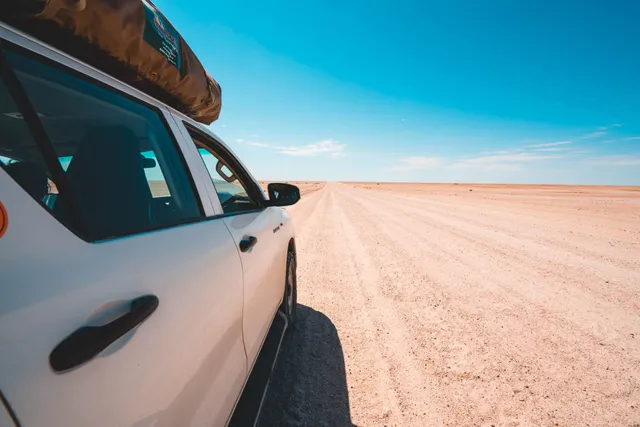
The so-called corrugated roads – gravel roads where the surface has compacted into wave-like ridges – are unfamiliar to most tourists. On top of that, SUVs with roof tents are a common hire car for a trip through Namibia. And it’s this combination that is the problem: the corrugated roads provide little grip, the higher centre of gravity of the car makes it easy for the vehicle to roll over. A car is still controllable at 60–70 km/h; anything above that reduces safety exponentially. If you start to skid at over 80 km/h, you can no longer control the car.
Ok, you may be wondering why you should start to skid, but there are many reasons. Animals can suddenly run across the road and other drivers can carry out dangerous overtaking manoeuvres you’re not expecting. If you see a large cloud of dust in your rear-view mirror or ahead of you, reduce your speed and let the car pass. In general, build in time buffers so you can take breaks and reach your destination in daylight.
Road conditions
As well as your speed, you should also be aware that road conditions are often poor. Very few roads in Namibia are tarmacked. That also applies to the main connecting roads, which start with a "C". The so-called pads are gravel roads with sometimes deep potholes and loose surface material.
You will also often come across hills where you can’t judge how the road continues. Your brain may tell you that the road carries on just as straight as it did on the way up, but that is often a fallacy. Suddenly there is a bend you’re not expecting and you start to skid. The raised centre of gravity can then quickly cause the car to roll.
Apart from that, you may also have a car coming towards you on your side of the road if it is in the middle of overtaking another vehicle. Just drive a bit more slowly, don’t race and bear in mind the inattention of other drivers. Then travelling on the roads becomes an adventure you really should experience.
Little tip: make sure your hire car has spare tyres. Two spare tyres are a good idea.
Weather
Speed and road conditions are one thing, the weather is another. In the rainy season roads are often completely flooded. On some routes you can still make good progress with a bit of care, but some roads suddenly become impassable. So always plan enough time so that, if in doubt, you can turn back and organise a different campsite.
Safety in Namibia with animals
If, when you think about safety in Namibia, animals come to mind, then you are probably mainly concerned with three things: animals and car accidents, camping in the wilderness and which animals are actually the most dangerous.
Car accidents involving animals
Car accidents involving animals occur mainly on night-time journeys between towns, but also during the day. Please don’t underestimate this, because a collision with a kudu, oryx or cow is comparable to a collision with a mid-range saloon car. On top of that, there is no requirement in Namibia to carry a first-aid kit. You might simply want to take one with you.
Camping in Namibia
Camping in Namibia, on the other hand, is pretty safe. After all, almost all campsites are fenced. The gates are open during the day, but accidents are still very, very rare. We always felt safe and often sat by the campfire until late in the dark.
So don’t worry too much about that. However, when you set off in the morning and head for a national park, it is often advisable not to get out. In Etosha National Park, for example, getting out of your vehicle is prohibited anyway. This is lion country, and you often only see them once they are already standing right next to you.
A little anecdote from us: in Etosha National Park we were parked at the side of the road to watch an eagle in a tree. About 15 minutes later we wanted to move on and happened to look out of the window on the other side. There was a whole pride of lions lying there, which we had completely overlooked. By then it was crystal clear to us that there really is a point to not just getting out without thinking.
Dangerous animals
So apart from lions, what dangerous animals are there in Namibia? On the one hand there are venomous animals such as snakes, scorpions and spiders. Snakes rarely attack without good reason, though. That’s also our experience: we saw a snake quickly flee up a tree as people approached. An exception is the puff adder, which basks on paths and is more aggressive than fearful. The same applies to the cobra, which as a defence mechanism deliberately spits venom into the eye of an attacker. So sunglasses can protect you from more than just the sun’s rays.
Accidents involving scorpions often happen when the animals have made themselves comfortable in clothing that isn’t being worn at the time. This includes, for example, shoes that have been left outside overnight. If you then slip your foot in without looking, you will provoke the animal to defend itself. So just shake out shoes and clothes before putting them on and you’ll be on the safe side.
It’s a bit different with big cats. While lions are less fearful, you will only see leopards and cheetahs with a lot of luck. These animals flee very quickly because they are extremely shy.
If you do ever get up close and personal with a predator, remember the African saying: "Only food is running!". If you start to run, you will inevitably trigger the animals’ hunting instinct. And every animal is faster than you – even the seemingly slow hippopotamus.
Other dangers involving wildlife
Herd animals such as bucks and kudus are not dangerous at first glance, but they are still wild animals. Their horns are not decoration but intended for defence. So keep a good distance and watch children carefully.
When accidents involving animals do happen, it is usually with elephants, hippos and crocodiles. To avoid encounters with crocodiles, you should consistently stay away from riverbanks. Elephants can overturn entire cars. Make sure you leave a lot of space (more than you would first think) and don’t park under a tree overnight if you can avoid it. You never know whether that tree is on the menu for the night. Did you know that hippos are the most dangerous animals in Africa, involved in the highest number of accidents? Give these animals a very wide berth. And remember: hippos always flee into the water – you don’t want to be in their way.
A few facts to finish: more accidents are caused by elephants and hippos than by snakes, scorpions and spiders. On top of that, there are 600 species of spider in Namibia and not one of them is life-threatening to a healthy person. Just wear sturdy shoes.
Diseases in Namibia
There are no mandatory vaccinations for Namibia, so we recommend that you ask a tropical medicine institute for advice. In our experience they tend to recommend more vaccinations than we would choose to have. For example, we were told that we absolutely had to have a flu jab because the risk of infection on the plane is high. Well. We are young and perfectly healthy. Whether that vaccination should be pushed with such insistence is open to debate.
Malaria
What you should know, however, is that there is malaria in Namibia. We have written an in-depth article about this which you should definitely read.
Drinking water
Tap water is not drinkable. So make sure you always have enough water with you or, if in doubt, boil tap water before drinking it. As the water is not drinkable, fruit and vegetables should also be washed thoroughly – using water from a container.
UV radiation
UV radiation in Namibia is quite high. The UV index is over 30. So if you are taking sun cream with you, go for a high sun protection factor.
HIV
There are many persistent rumours surrounding HIV. Statistics show that 9.5% of people aged 15–49 in Namibia are infected with HIV (source: unaids.org). That is a shockingly high figure, but significantly lower than the rumours would have you believe. So definitely pack plenty of disposable gloves in case you need to give first aid. There are only 0.36 doctors per 1,000 inhabitants, which means that initial medical care often depends on whoever is on the spot.
Religious violence
While there is increasing fear of religious attacks in the western world, there are none in Namibia. There is no religious violence, no terrorist attacks and no ethnic conflict.
How to behave in a threatening situation
There probably isn’t a magic formula that someone can give you. However, we recommend that you buy a SIM card in Namibia at the airport so you can call for help. Bear in mind though that coverage is not nationwide. You can find all the information on network coverage in the linked article. You might also want to think about a satellite phone. With that you can call for help wherever you are.
Our tip is also to give emergency numbers to family, friends and/or acquaintances in case you don’t have them to hand yourself. This also includes, for example, the number of your car hire company. Leave copies of your identity documents and/or store them in the cloud so you have them with you on site if needed. In any case it’s a good idea to have your travel health insurance details easily accessible. You’ll need these in order to receive medical treatment.
Conclusion on safety in Namibia
Quite a lot of information, isn’t it? To go back to the beginning of the article: in our opinion the security situation in Namibia can’t be assessed in such broad terms as the Federal Foreign Office or the Exop Group do.
Namibia is not generally an unsafe country, but it’s not an entirely safe one either. A large part of your safety is determined by your own behaviour. And that’s where you come in. Engage with the topic of safety, but don’t become paranoid.
In Europe, safety in the face of terrorist attacks is not 100% guaranteed either. It would be such a shame if you were too afraid and therefore missed out on seeing Namibia’s wonderful landscapes. That really would be a pity. With sufficient respect for people’s poverty, the poor road conditions and the wild animals, you can optimise your safety to a comfortable level. We wish you a safe journey!
Pour aller plus loin
Planifie ton voyage dans l’app.
Enregistre activités et hébergements, compose ton itinéraire et emporte tout hors ligne.