Translated from German. We write our content in German.Show original
Walvis Bay: Flamingos off the coast

By Laura & Tobi ·
In the region south of Swakopmund you can see the Walvis Bay flamingos. A spectacle you really should not miss.
In the region south of Swakopmund you can see the Walvis Bay flamingos. Around 50,000 flamingos find their food here before they fly to their breeding grounds at the end of the rainy season. It is a unique spectacle that you should definitely plan into your journey to Swakopmund.
Walvis Bay
Walvis Bay is a small place on the west coast of Namibia. With around 63,000 inhabitants the small town municipality belongs to the Erongo region and lies roughly 30 km south of Swakopmund. The whale bay is Namibia’s most important seaport and is vital for supplying the country.
Because of the Benguela Current, which brings cold water from Antarctica to the coast of Namibia, there is a high abundance of whales and fish. Thanks to the cool water and the wind it rarely gets warmer than 20°C in Walvis Bay – even in summer.
Walvis Bay is known for its dolphins, whales and rare fish such as the ocean sunfish. But you can also discover around 40 different bird species here, including herons, pelicans and of course flamingos.
Looking for the flamingos
We are already excited, as we have seen lots of photos beforehand showing flamingos in Walvis Bay. And quite a lot of them. We have never seen flamingos in the wild before and can’t really imagine suddenly seeing the birds in such huge numbers.
So we drive from Swakopmund to Walvis Bay and are initially surprised that the “town” is more like a large industrial area. We drive along the streets and spot tall radio masts decorated at the top with artificial palm fronds. They are meant to look like palm trees. All in all the industrial feel plus the fake “antenna palms” is somehow absurd. But there are supposed to be flamingos here.
We carry on driving towards the water. Lagoon Promenade Road (or D1986) runs along the waterfront. At last we also see a few residential houses. All the houses face the sea and have huge front windows. Sitting here in the evening while the sun goes down must be wonderful. Especially when flamingos then pass by in your “front garden”. But where are they actually?
Walvis Bay flamingos
We drive on and suddenly see something in the water in the glaring sunlight. We keep going, park the car and get out. They really are flamingos! At first we only see a few, until suddenly a huge group appears. They really are here! It is a slightly surreal sight, with some of them standing on one leg with their heads tucked into their feathers, while others are busily trying to find something to eat.
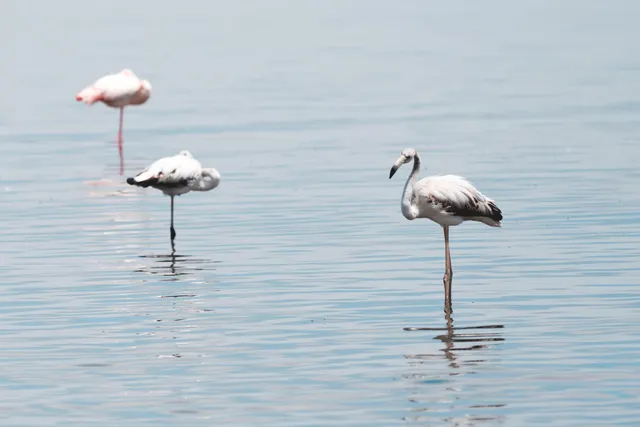
We keep on driving, because somehow this can’t be all there is. At peak times you are supposed to be able to see 50,000 Walvis Bay flamingos here and we have seen a handful.
We continue to a lagoon that is said to be around 5,000 years old and to hold lots of shrimps, mussels, plankton, small fish and algae. If they are not here, then where?
We arrive and can hardly believe it. Hundreds, if not thousands of flamingos can be seen here! Small and large ones, white and pink. The large ones are the greater flamingos, also called pink flamingos in German. The smaller ones are so-called lesser flamingos. You can probably guess which are the big ones and which are the small ones :-)
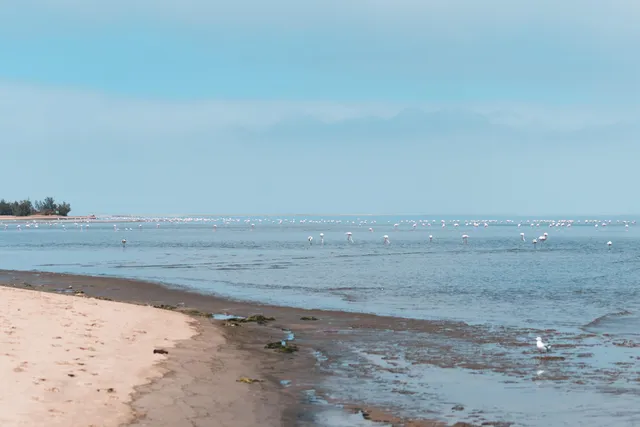
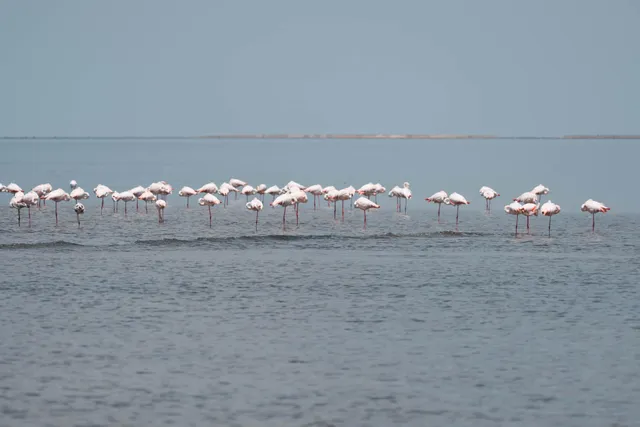
We later read that 80% of all flamingos in southern Africa come here to feed. Around 40% of the large pink flamingos even live here permanently. We are so glad we came!
Walvis Bay flamingos: when are they there?
Fortunately flamingos can be seen there all year round, although the number of birds varies over the course of the year. This is mainly because they have two other places where they feel at home: Makgadikgadi Pan in Botswana and Etosha National Park in Namibia. These are where the flamingos’ breeding sites are found.
At the end of the rainy season in Namibia, when the salt pans in Etosha National Park fill with water, a small group of flamingos flies there. The group then checks whether there is already water. If that is the case, the birds stay there and the rest follow on gradually. Then they begin to breed.
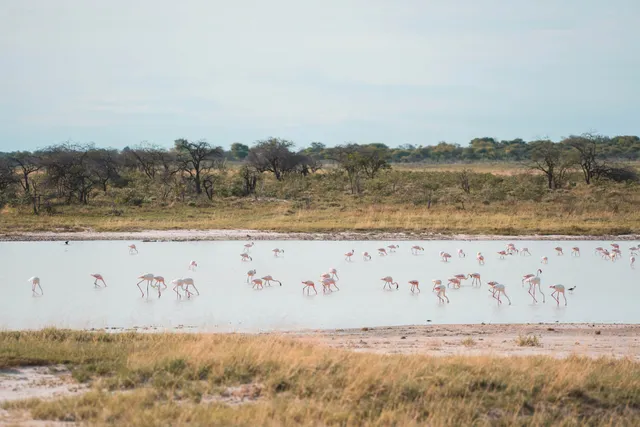
We were very lucky and were able to see the flamingos in Walvis Bay and later again in Etosha National Park. We found it somehow very special to see these birds where they live in their natural environment. We could easily have watched for hours as the flamingos searched for food in the shallow water.
Have you ever seen flamingos in the wild? Tell us about it in the comments.
Plan your trip in the app.
Save activities and places to stay, put your route together and take everything with you offline.