Cette page n’existe pas encore en français : nous te montrons la version disponible.
Rhino poaching: a real problem in Africa

Par Laura & Tobi ·
Rhino poaching is a real problem in Africa. In this article you can find out more about a rhino that puts a face to it all.
Above us stretches an endless starry sky. Tonight it is full moon and it lights up the surroundings so much that we can clearly see our hand in front of our eyes. The moon shines so brightly that even the trees cast shadows. We have never seen anything like it. The full moon in Africa fascinates us. And suddenly one of us says: "These are perfect conditions for poachers now."
A different night, a different place. We have been lying asleep in the roof tent for hours. We woke because, in the distance, a loud rumbling breaks through the night. The sound of a vehicle driving along the sandy tracks comes closer and closer. Spellbound, we listen to the noise. As it drives past our camp, the bushes are briefly lit up by the headlights. The rumbling grows quieter again and disappears into the night. Outside, in front of the tent, nothing seems to be moving. A shiver runs down our spine before we fall asleep again.
The next morning we ask about it. What was that vehicle? A member of staff at the camp tells us that it was a vehicle from the anti-poaching unit. In Botswana the rangers are instructed to shoot poachers without further ado. On our journey through Botswana we see anti-poaching units with their vehicles a few more times near the border with Namibia.
Since our trips to Namibia and Botswana, poaching has increasingly come into our focus. The impressions we brought back from there gave us a new sense of the inaccessibility and vastness of the wilderness areas. In Namibia and Botswana we travelled through regions that were endlessly wide and lonely. How difficult must it be to pick up the trail of poachers out there? How incredibly hard is it to protect wild animals out in the bush?
Rhinos in the wild
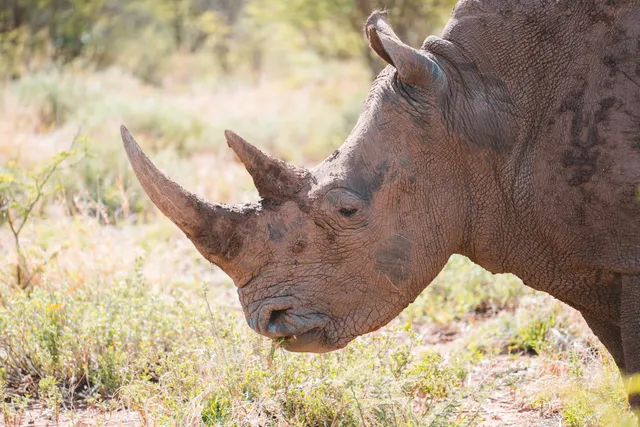
On our trip to Namibia we were lucky several times to encounter rhinos in the wild. At times we came very close to these animals that look as if they came from another age. We were able to observe rhinos in Etosha National Park and in a private reserve.
It is incredibly impressive to watch these animals. They are so much larger than we had imagined and, with their small eyes, they seem such a paradox: powerful and peaceful at the same time.
We are even able to watch a young animal with its mother. The youngster already has a small horn that stands out above its mouth. And it is precisely because of this horn that rhinos are poached. So intensely that the two are constantly accompanied by rangers. We do not see the rangers. For us, the protection unit remains invisible in the bush.
Rhino poaching
Due to the extremely high demand for rhino horn, an estimated 769 rhinos were poached in 2018. Most of these animals were in South Africa, as this is where the world’s largest population lives. But poaching is currently also increasing in the countries of Namibia and Zimbabwe.
Since 2007 poaching has increased significantly again in Africa. The record number of poached animals in recent years was reached in 2014 with 1,215 rhinos killed. A sad and shocking figure at the same time, because the number of poached animals is now higher than the birth rate.
Trackers locate the animals in the vast bush and pass the position on to shooters. Corruption at all levels of the trade chain makes it possible to get the horn to its destination country.
Number of rhinos poached from 2014 to 2018 in southern Africa (source: WWF):
- 2014 = 1,215 rhinos killed
- 2015 = 1,175 rhinos killed
- 2016 = 1,054 rhinos killed
- 2017 = 1,028 rhinos killed
- 2018 = 769 rhinos killed
These high figures mean that heavily armed and specially trained rangers often patrol the parks. Heavily armed so that they can stand up to the ruthlessness of the poachers and protect the rhinos, as well as their own lives.
Why is there poaching?
In traditional medicine in parts of Asia, rhino horn is said to have a healing effect. A rhinoceros horn consists largely of keratin and can best be compared to a feather or fingernails. So far there is no scientific study that proves it has any healing effect. And yet in Vietnam, where most of the horn currently ends up, cancer is treated with rhino horn. In traditional medicine it is also used as a remedy to reduce fever and relieve cramps.
Most horn reaches Vietnam and China via smuggling routes. There it is traded not only as a remedy but also as a luxury object. On the black market, horn fetches twice as much as gold. The extremely high demand drives up the price and with it the ruthlessness with which animals are poached.
A rhino puts a face to poaching
It is estimated that every 8 hours a rhino is attacked in Africa. As soon as the animal’s horn has been removed, it is left to its agonising fate. This is what happened to Hope, a young female rhino from South Africa. A huge hole gaped above her mouth up to her forehead. Part of her mouth had been smashed away, the sinuses were exposed.
But Hope survived the cruel attack. It is incredible, as she wandered through the bush severely injured for several days before she was found by rangers.
A team of helpers and vets from "Saving the Survivors" did everything they could to help Hope. The rhino had to undergo several operations, with the aim of closing the huge wound on her face. Not an easy path for Hope, but this rhino had already shown her strong will to live and thus became a symbol in the fight against brutal poaching.
Using various techniques, a cover in the form of a shield was fixed over the wound. Where the bone structure was intact, the shield was attached with screws. Where there was no bone, binding techniques were used. The vets experimented with methods from state-of-the-art human surgery, were successful and learned from it. As little was previously known about the anatomy of the rhino skull, this meant for the vets: making the impossible possible.
It seemed to be working, and confidence grew that Hope would make it and one day be released back into the wild.
The sad news came in November 2016. Hope was found dead in her enclosure. The likely cause of death was a bacterial infection of the small intestine.
Saving the victims of poaching
Alongside several organisations that campaign for the protection of rhinos, Saving the Survivors is committed to treating badly injured wild animals. As it is particularly rhinos that are found with severe injuries, the focus of the work is on these animals. The aim is to provide injured wildlife with the best possible treatment and thus increase their chances of survival. We think the work of the team is fantastic and it deserves great respect.
If you would like to find out more about the work of Saving the Survivors or support the victims of poaching with a donation, you can do so here.
Pour aller plus loin
Planifie ton voyage dans l’app.
Enregistre activités et hébergements, compose ton itinéraire et emporte tout hors ligne.