Cette page n’existe pas encore en français : nous te montrons la version disponible.
Namibia rainy season: What should you expect?

Par Laura & Tobi · ·
You’d like to travel during Namibia’s rainy season and you’re not sure if it’s a good idea? Here we share our experiences.
Namibia in the rainy season – is that really a good idea? Many people shy away from travelling between November and April. Yet this time of year can be a truly special experience. In this article you’ll find out what defines Namibia’s rainy season, how rain and climate affect safaris, camping and road conditions – and whether this time of year is right for you.
When is the rainy season in Namibia?
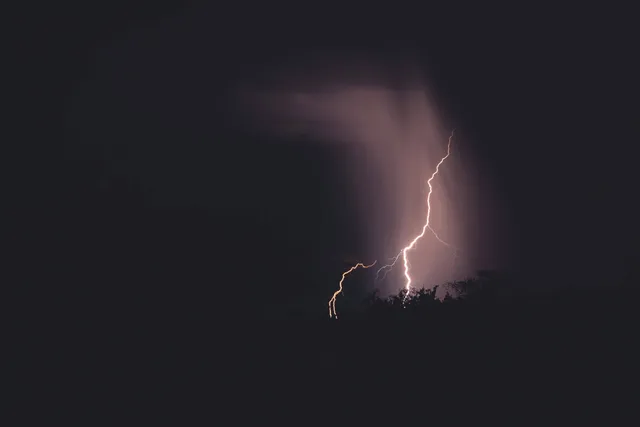
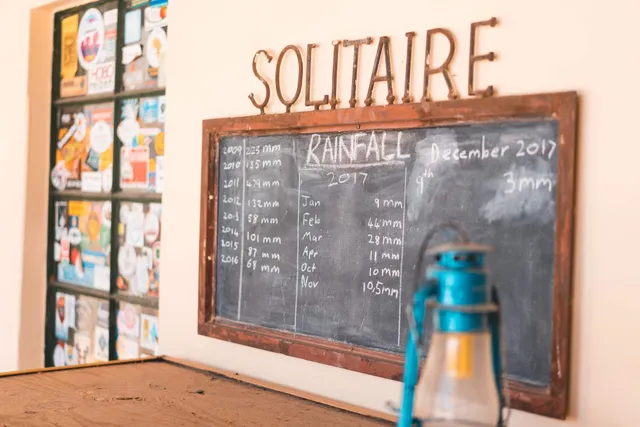
The rainy season in Namibia lasts roughly from November to April, with the peak in January and February. It is hot, at times humid, and there can be short, heavy showers and thunderstorms. The rain is often very local – it can be pouring down in one place while just a few kilometres away it stays dry.
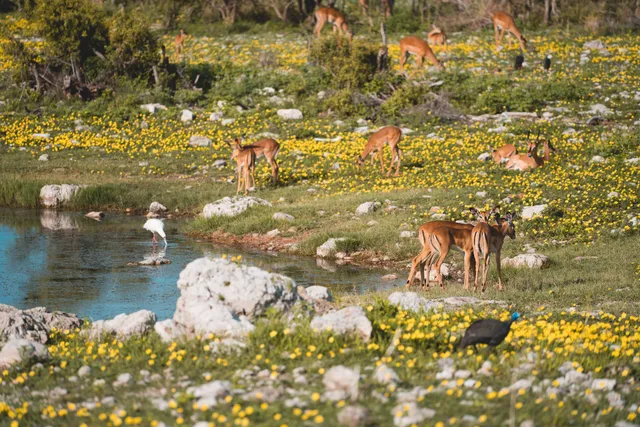
Nature reacts immediately: barren landscapes turn green, dry riverbeds fill with water and the animals enjoy new water sources. For travellers this means Namibia appears in a completely different light compared to the dry season.
Climate during Namibia’s rainy season
During the rainy season temperatures in many parts of Namibia rise to 30 to 35 °C, sometimes even higher. It can get very hot in the desert, while at night it usually cools down pleasantly. On the Atlantic coast – around Swakopmund or Walvis Bay – temperatures are much milder, at around 20 to 25 °C during the day. Due to the increased humidity it can feel humid, especially in the north and east of Namibia.
If you don’t cope well with heat, you should rather travel in the cooler shoulder months – or focus on regions with a more moderate climate.
Namibia rainy season: Advantages and disadvantages at a glance
Advantages:
- Greener landscapes, desert in bloom, dramatic skies
- Fewer tourists, more peace and quiet in national parks
- Lower prices for accommodation and hire cars
Disadvantages:
- Animals are harder to spot, as they no longer stay only at waterholes and the vegetation is denser
- Roads can temporarily become soft or more difficult to drive
- Camping in heavy rain can become uncomfortable
Our route during the rainy season in Namibia
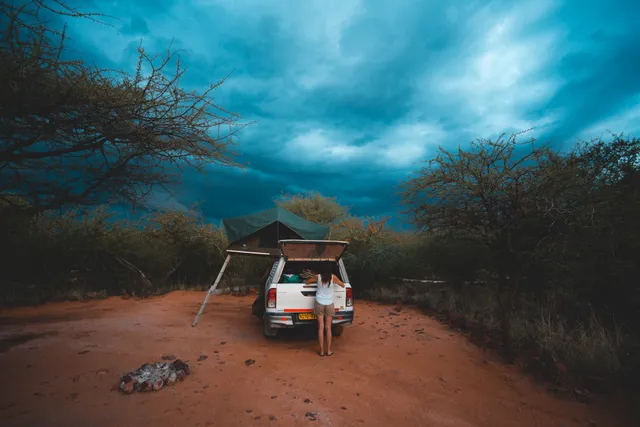
We travelled from mid-January to mid-February with a Toyota Hilux with roof tent – an adventure right in the heart of the rainy season. Our route took us from Windhoek via the NamibRand Nature Reserve to Sesriem and Sossusvlei, then on along the C14 to Walvis Bay and Swakopmund. From there we continued via the Spitzkoppe towards Kamanjab, into Etosha National Park, on to the Waterberg Plateau, into the Erindi Private Game Reserve and finally back to Windhoek.
Not all regions of Namibia are equally suitable for self-drivers during the rainy season:
- The Caprivi Strip (Zambezi Region) is known for deep sand tracks and can be difficult to pass after heavy rainfall.
- In remote areas such as along the Hoanib or Hoarusib rivers in the Kaokoveld, flash floods can suddenly occur if it has rained further inland – at times even sweeping cars away.
Safari in the rainy season: Is it worth it?
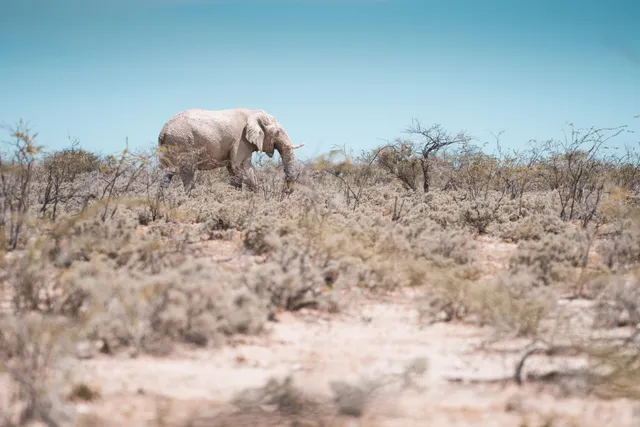
Many people fear that wildlife viewing in the rainy season will be disappointing. And yes – because of the green vegetation it is harder to spot animals from a distance. Predators in particular, such as lions or leopards, are difficult to make out in the dense vegetation. Natural water sources also form, meaning animals visit artificial waterholes less often, although these are excellent viewing points in the dry season.
But we still saw all the big animals – except for free-ranging cheetahs and leopards. Elephants, rhinos, giraffes, lions, hyenas and countless antelopes – everything was there. With patience and binoculars, a safari in the rainy season is still a fantastic experience.
Camping during the rainy season
Camping in the rainy season requires flexibility. In our case the roof tent was mostly well sealed – but on one particularly rainy night in Etosha it dripped in at one spot because the tent wasn’t completely watertight there. Our tip: definitely pack some duct tape – you can fix almost anything with it on the road. It’s not on our Namibia packing list for self-drive camping safaris for nothing. Thanks to the hot daytime temperatures everything dries very quickly.
The key is your equipment: a good rain jacket, a dry storage area and a relaxed attitude help enormously. Many campsites have covered areas and pools – a welcome way to cool off in the midday heat.
Road conditions during Namibia’s rainy season
Most main and secondary roads were easy to drive. Only a few stretches had been softened by rain – such as between Etosha and the Waterberg Plateau.
With a 4x4 vehicle such as the Toyota Hilux we never had any problems. Now and then we had to drive through puddles or switch to four-wheel drive – which actually made the journey more adventurous. For motorhomes or normal cars it can, however, become difficult.
Activities in the rainy season: What’s possible?
Many activities are also possible during the rainy season – and some are even more pleasant:
- Go hiking in the morning or late afternoon if possible
- Climbing the dunes in Sossusvlei no later than 10.30am
- Kayaking with seals and outdoor adventures in Swakopmund and Walvis Bay
- Wildlife watching in Etosha and in game reserves
In the midday heat it was too hot for long hikes in some places (for example at the Spitzkoppe). But the photo opportunities created by the dramatic clouds and lush green bush were unique.
Conclusion: Is Namibia’s rainy season right for you?
Yes, if you...
- are looking for an adventure away from the typical main travel season
- are happy to travel in the low season and would like to benefit from lower prices for accommodation and hire cars
- would like to discover Namibia’s green side
Probably not, if you...
- are hoping to see lots of animals at the waterholes – as is often the case in the dry season, when animals are drawn there because there are hardly any other sources of water
- don’t want to hire a 4x4 vehicle
- don’t like high temperatures above 30 degrees
We thoroughly enjoyed our trip during the rainy season – despite a few challenges. The landscape was breathtaking, the lodges and campsites were empty, and the wildlife was lively. That said, we personally are not so keen on the very high temperatures. Even though the green vegetation is beautiful, we now tend to prefer the shoulder months or the dry season – simply because the temperatures are much more pleasant then.
Do you want to know which places are at their best in the dry season? Take a look at our Namibia travel guide. There you can browse through the most beautiful regions and find inspiration.
And for on the road: in the app you’ll find offline tips on campsites, activities and wildlife sightings.
Namibia is an adventure land you can travel to all year round – and it is well worth a trip even in the rainy season!
Pour aller plus loin
Planifie ton voyage dans l’app.
Enregistre activités et hébergements, compose ton itinéraire et emporte tout hors ligne.