Cette page n’existe pas encore en français : nous te montrons la version disponible.
Hire car without camping equipment

Par Laura & Tobi · ·
Depending on the region, a different vehicle is recommended. On this page we help you find the hire vehicle that suits you and your route.
In Namibia, four-wheel-drive vehicles (also called 4×4 vehicles) are recommended. These are often SUVs (continuous cab) or off-road vehicles with a rear canopy. The latter come as a single cab (single cab for a maximum of 2 people) or double cab (double cab for a maximum of 4 people).
What should you look out for when choosing a vehicle?
We recommend a vehicle with four-wheel drive for Namibia. Even though many routes can easily be driven without four-wheel drive, from our point of view there are two reasons that speak in favour of a four-wheel-drive vehicle:
- Safer: We generally recommend driving with four-wheel drive (H4) engaged. Road holding is better because all four wheels grip. In sudden manoeuvres (for example swerving to avoid a vehicle or animals) the car is more likely to stay on track. Diesel consumption increases only marginally by 0.5 l per 100 km. For a total driving distance of 3,000 km that comes to about 15 EUR.
- Carefree: Many routes in Namibia are so-called pads (gravel roads). These can also be driven without four-wheel drive. In Namib-Naukluft Park in Sesriem it happened to us on one trip that a vehicle without four-wheel drive got stuck in light sand on a campsite. With 4x4 this will not happen to you.
What vehicle models are there?
In Namibia you can usually choose between three vehicle models: Toyota Hilux, Toyota Fortuner and Toyota Land Cruiser:
- Toyota Hilux: The most popular vehicle in Namibia and worldwide is the Toyota Hilux. The vehicle is sufficient for almost all regions of Namibia. The car is powerful and has four-wheel drive.
- Toyota Fortuner: An alternative is vehicles with a continuous interior such as the Toyota Fortuner. In these vehicles no sand or dust reaches your luggage.
- Toyota Land Cruiser: If the terrain is particularly demanding, a Toyota Land Cruiser can also be a good and comfortable alternative. However, it is not absolutely necessary. It is available as a pickup and as a Prado with a continuous interior.
Toyota Hilux - best value for money recommendation
The Toyota Hilux is the most popular and cheapest vehicle in Namibia. The Hilux is perfectly suitable for all regions covered in the travel guide.
If you would like a little more power and ground clearance, then the Hilux with safari equipment can be a good alternative for you. The underbody is often not insured in Namibia. However, if you avoid the north-west of Namibia (Palmwag and Kaokoland), the additional ground clearance is not really necessary.
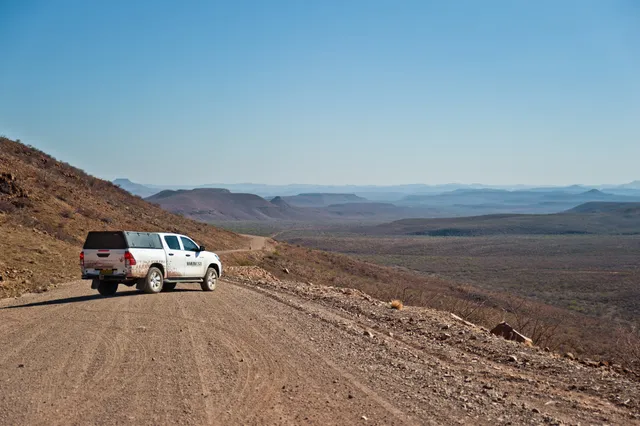
In Namibia, almost all car hire companies offer the Hilux. We provide an overview of the providers. Be sure to pay close attention to included services and hidden costs. We help you with this.
- AfriCar Car Hire
- Insurance cover disproportionately expensive.
- Africa on Wheels
- Subsidiary of Caprivi Car Hire, set up to offer older vehicles at lower prices.
- Asco Car Hire
- One of the biggest 4x4 car hire companies. New and older vehicles are available.
- Savanna Car Hire
- Large fleet with higher-than-average insurance prices.
- Bushlore
- Premium provider with above-average equipment at comparatively higher prices.
Toyota Fortuner - sand protection for your luggage
The Toyota Fortuner is a good alternative to the Toyota Hilux. Since your luggage can be stowed in the interior, it is protected from sand and dust. However, the Fortuner is a little more expensive than the Hilux.
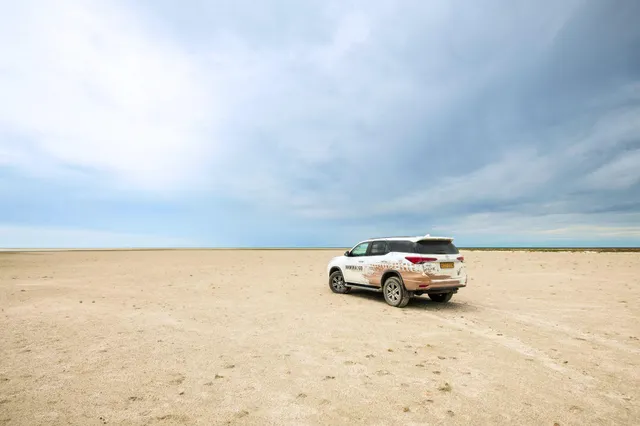
The Fortuner is suitable for all regions covered in the travel guide. In Namibia, almost all car hire companies also offer the Fortuner. We provide an overview of the providers. Be sure to pay close attention to included services and hidden costs. We help you with this.
- AfriCar Car Hire
- Insurance cover disproportionately expensive.
- Africa on Wheels
- Subsidiary of Caprivi Car Hire, set up to offer older vehicles at lower prices.
- Asco Car Hire
- One of the biggest 4x4 car hire companies. New and older vehicles are available.
- Savanna Car Hire
- Large fleet with higher-than-average insurance prices.
- Bushlore
- Premium provider with above-average equipment at comparatively higher prices.
Toyota Land Cruiser - for extreme demands
The Toyota Land Cruiser is the most powerful vehicle in this selection and is suitable for regions that are very demanding – such as the north-west of Namibia with steep climbs and loose scree. The Land Cruiser masters extreme gradients with ease. In return, the car is also significantly more expensive than the Hilux or Fortuner.
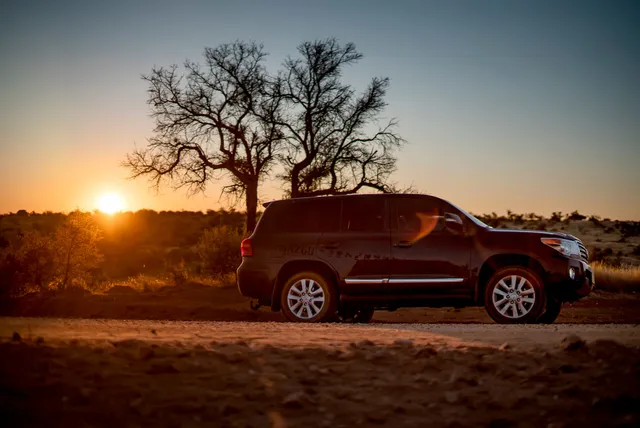
The Land Cruiser is suitable for all regions covered in the travel guide. In Namibia, almost all car hire companies also offer the Land Cruiser. We provide an overview of the providers. Be sure to pay close attention to included services and hidden costs. We help you with this.
- AfriCar Car Hire
- Insurance cover disproportionately expensive.
- Africa on Wheels
- Subsidiary of Caprivi Car Hire, set up to offer older vehicles at lower prices.
- Asco Car Hire
- One of the biggest 4x4 car hire companies. New and older vehicles are available.
- Savanna Car Hire
- Large fleet with higher-than-average insurance prices.
- Bushlore
- Premium provider with above-average equipment at comparatively higher prices.
Providers in cost comparison
We have calculated a fictional 21-day holiday from 18 May to 8 June 2024 with various providers for you. The basis in each case was a Toyota Hilux (double cab) for two people and reduction of the excess to zero (including tyre and glass cover). Where possible, we chose the budget option (not a new vehicle).
| Provider | Rental | Insurance | Total | Note |
| Savanna Car Hire* | 1.023 EUR | 595 EUR | 1.619 EUR | Two spare tyres and all windows are insured. |
| Asco Car Hire* | 1.562 EUR | 525 EUR | 2.087 EUR | One spare tyre and all windows are insured. |
| Africa on Wheels* | 1.725 EUR | 556 EUR | 2.281 EUR | Excess reduced to only 2.000 NAD (approx. 100 EUR). All tyres and windows are insured. |
| AfriCar Car Hire* | 1.529 EUR | 794 EUR | 2.323 EUR | Two spare tyres and one windscreen are insured. |
| Bushlore* | 2.472 EUR | 490 EUR | 2.962 EUR | All spare tyres and windows are insured. |
How are the costs made up?
In principle, the prices are made up of two components:
- Age of the vehicle: Many providers let you choose between a relatively new car and an older model. The latter is often offered as a so-called "budget option". The cars are always great; you usually just forgo things like a USB port.
- Daily rental rate: The daily rental rate depends on the vehicle type, the season (low, shoulder or high season) and the rental period (often up to 15 days and from 16 days).
- Insurance cover: The car hire companies usually offer basic insurance cover as standard. This includes third-party liability, accident, theft and fire insurance with an excess and security deposit. You can reduce the excess and deposit for an additional charge.
Optionally you can add further services:
- Additional driver: If you want to take turns driving on the trip, you need to book an additional driver.
- Equipment: The providers differ in terms of standard equipment. With some, for example, sand tracks are included, with others you pay an extra fee for them. So check what is included and add the fee for your desired equipment to the rental price. Satnavs, satellite phones, etc. always cost extra.
- Expedition equipment: The Toyota Hilux is also available with expedition equipment. The vehicle is then usually slightly raised and has a snorkel so you can drive through deep water more safely.
What is insured?
In most countries in southern Africa there is no compulsory insurance. As a result, most cars are not insured, so owners have to pay for damages out of their own pocket. Given the often poor financial situation you should not necessarily count on compensation. It is therefore advisable to take out sufficient insurance.
This is always insured…
- Theft: If the renter locked the vehicle and still has all the keys, theft is insured.
- Accident: Occupants are insured in the event of an accident. However, you still need overseas health insurance.
- Comprehensive cover: Damage to your own vehicle is often only partially insured. It does not matter whether you or third parties are responsible for the damage.
- Third-party liability: Damage to third parties is often insured up to cover of 1 million euros.
This can additionally be insured…
- Tyres: Flat tyres are not uncommon given the road conditions. However, these are often not covered by the basic insurance.
- Windows/headlights: On gravel roads there is also repeated damage to windows and headlights. These are likewise rarely insured.
- Undercarriage: Numerous potholes also mean that damage to the undercarriage can occur. This too is often not covered by the basic insurance.
- Water: If you have to drive through water and damage occurs, this is also rarely included in the basic insurance.
- Rollover: Because of the roof tent you have a different weight distribution. If you drive too fast and swerve sharply due to a hazard, the vehicle can quickly roll over. This is also not insured.
- Incorrect operation: If the engine, clutch or similar fails and incorrect operation on your part can be proven, this is likewise not insured.
Our recommendation for you
If you use one of the routes we recommend for your trip planning, then a Toyota Hilux or Toyota Fortuner is absolutely sufficient for you. However, if you are planning a detour into the north-west (e.g. Kaokoland), then expedition equipment or a Land Cruiser is recommended for you.
When choosing a provider, make sure that the equipment you need is included, or factor in the additional fee for equipment that is not included. The advertised services (e.g. transfer to and from the airport) do not differ between providers. That is standard.
With the insurance, reducing the excess also means that you have to pay a lower deposit on arrival. Otherwise this amount would be blocked on your credit card limit.
As a general rule, driving through the Caprivi is less hard on the tyres because of the deep sand than driving on gravel or rocky roads. In addition, sandstorms occur more frequently near the coast because of the wind and fine sand. These can cause the windows to become cloudy. You can bear this in mind when choosing additional insurance.
Pour aller plus loin

Planifie ton voyage dans l’app.
Enregistre activités et hébergements, compose ton itinéraire et emporte tout hors ligne.