Translated from German. We write our content in German.Show original
Buying a SIM card abroad: everything you need to know

By Laura & Tobi ·
If you buy a SIM card abroad, you’ll save on expensive roaming charges. We’ll show you what you really need to look out for when buying one.
You’d like to buy a SIM card abroad and aren’t quite sure what the best option is? In this detailed guide we’ll show you:
- Four options for buying a SIM card abroad
- The cheapest option using Namibia and Canada as examples
- And a trick for sharing your data volume.
The most important points at a glance
You have four options for buying a foreign SIM card:
- Add an international option: you book an add-on package with your domestic network provider
- Foreign SIM by post: you have a foreign SIM card sent to you
- Foreign data volume via app: you book foreign mobile data on the go via an app
- Buy a SIM card locally: you pick up a foreign SIM card at the airport on arrival
You should definitely compare the different options for your destination country. Our recommendations for Namibia and Canada:
- Namibia: For Namibia it often makes sense to buy a local SIM card from mtc at the airport. For 1 GB you pay the equivalent of around 2 EUR and you also get inclusive minutes and texts.
- Canada: In Canada prices are high. Through providers such as Airalo* or Nomad* you can book foreign data volume and keep your domestic SIM card in your phone. 1 GB of data volume is available from Nomad for 7 dollars.
What options do you have for a SIM card abroad?
When you’re travelling abroad you’ll almost certainly want to look something up on the internet or book accommodation by phone. It’s also reassuring to know you can call for help in an emergency. We’ll show you which options you have and which one is best for you.
1. Add an international option
For some time now the so-called EU roaming rules have applied in Europe; they were updated again on 1 July 2022. The rules apply to all contracts – including prepaid contracts.
The key points are that…
- Calls, texts and mobile data within the EU cost the same as they do within Germany
- Incoming texts are always free
However, when you travel outside the EU things can get more expensive. It may well make sense to add an international option to your German mobile phone contract. The exact process varies slightly depending on the mobile provider:
- Telekom: With the so-called “Travel & Surf Pass” you can also surf abroad. Deactivate Wi-Fi and then go to http://pass.telekom.de. There you can book a pass. 100 MB costs e.g. 4.95 EUR and 1 GB costs 29.95 EUR.
- Vodafone: Vodafone offers international options too, with EasyTravel (only some countries, including the USA and Canada) and ReisePaket World. You then use your contract as you would at home. You book via the MeinVodafone app. You can find more information here.
- Telefonicá or o2: Here the international options are divided into zones. Canada for example is in zone 3 and costs 4.99 EUR for 50 MB of data volume. Calls cost 1.49 EUR to Germany or within the zone. You can find more information here.
Our recommendation for you: this option is often very expensive, but it can be worth it if, for example, you’re only making a stopover and need internet access quickly and conveniently.
2. Order a foreign SIM card to your home
An alternative can be to buy a foreign SIM card and have it delivered to your home. Compared to the international options offered by German mobile providers, the prices are usually much more attractive. Once you’ve received the card, you insert it into your phone.
When choosing a provider, bear in mind that prices vary greatly. One provider may offer the best deal for one country but have above-average prices for another. So it’s always worth comparing. We compare the providers using Canada and Namibia as examples:
- Travsim: At Travsim.de there is a 22 GB tariff for Canada whose price varies depending on the length of your trip. For 15 days it costs 39.95 EUR and for 21 days already 59.95 EUR. At the moment there is no SIM card available for Namibia.
- Reisesim: At Reisesim you buy credit for Canada, which you can use to make calls or surf the internet. However, the price per MB is 0.39 EUR. You can cap the costs with an internet data package. For 14 days you get 125 or 250 MB for 19 or 35 EUR respectively. For 30 days you then get 500 or 1,000 MB for 69 or 95 EUR respectively. For Namibia there is an option for calls, but without data volume.
- Simly: The provider Simly also offers options for Canada, but not for Namibia. The tariff for Canada includes 15 GB of data volume and, for a 30-day usage period, costs 59.90 EUR.
- Lufthansa Mobile: Who would have thought that Lufthansa is also a mobile provider. With a SIM card from Lufthansa Mobile you can surf in Canada and Namibia for 0.04 EUR per MB. That doesn’t sound like much, but it still adds up to 40 EUR per GB. On the plus side, you don’t have to commit to a specific term.
One disadvantage of a foreign SIM card is that you either have to replace your domestic SIM card and will no longer be reachable on that number, or you need a dual SIM phone that can take two physical SIM cards.
- iPhone: There are iPhones with dual SIM, but you can’t insert a second physical SIM card into them.
- Android: In some Android smartphones you can insert a second SIM card. Check whether that’s the case with your smartphone.
Our recommendation: the tariffs are cheaper than the international options from your domestic mobile provider, and you can still set everything up conveniently from home. In the next section you’ll find an alternative to a physical SIM card.
3. Buy internet abroad via an app
In addition to a physical SIM card that is sent to your home by post, you can also use a so‑called eSIM. This is purely digital and can be used with a dual SIM smartphone, e.g. from the iPhone XR – including iPhone 11, 12 and 13 – or a newer Android model.
Your advantage is that you can book an eSIM tariff from anywhere in the world and your smartphone and your original SIM card remain untouched. This means you can, for example, simply book additional foreign data volume.
We have compared three providers for you:
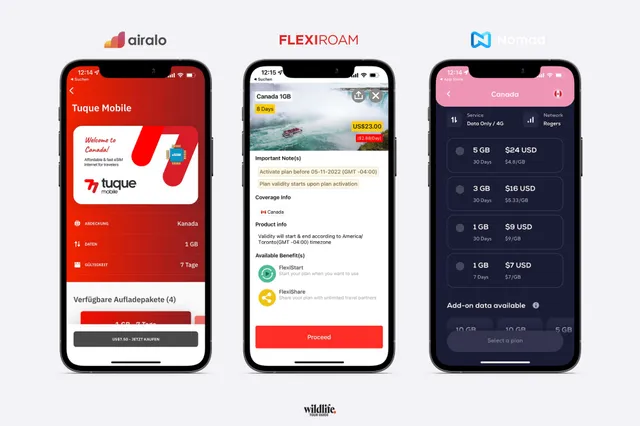
- Airalo: Via Airalo* you can book data volume in your destination country for 190 travel countries using the Airalo app. You take out a tariff for a duration of 7 or 30 days. 1 GB costs 7.50 USD in Canada for 7 days. You can get 3 GB for 30 days for 17.50 USD – 5 GB for 25 USD and 10 GB for 36 USD. There are no tariffs for Namibia.
- Flexiroam: The provider Flexiroam* also offers tariffs for Canada. For comparison we have looked up the price for 1 GB with a validity of one week. The cost is 23 USD. That is expensive. On the other hand, there is a tariff for Namibia. With ‘Global Prepaid Mobile Data’ you can use 1 GB for 90 days and pay 29.99 USD.
- Nomad: The provider Nomad* also offers a tariff for Canada and 100 other countries for comparison. For comparability we also looked at 1 GB for 7 days. The price is 7 USD and is therefore cheaper than Airalo. Namibia is not included.
Compared with the previous options, the eSIM alternative is the cheapest. You get 1 GB of data volume for 7 USD, you can keep your home SIM card and conveniently top up data volume abroad.
Our recommendation: If you have a dual SIM smartphone this option is not only convenient but also significantly cheaper than the previous alternatives.
4. Buy a prepaid SIM card abroad on the spot
Another option is to buy a foreign SIM card locally. SIM cards are available in almost every country and the prices are often unbeatable compared with the previous options. You can often buy them directly at the airport and have the staff set them up for you.
Once again we have picked out providers for Canada and Namibia as examples for you:
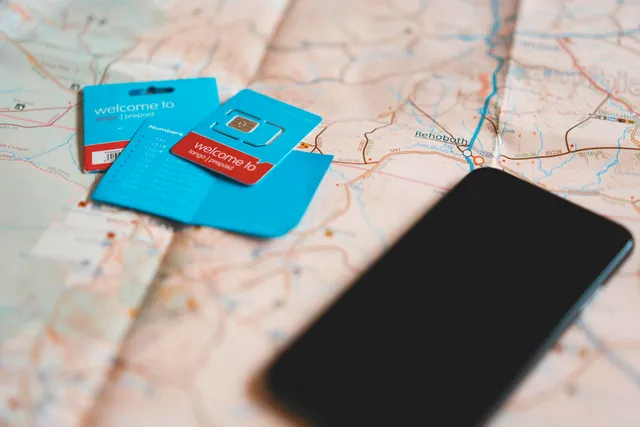
- Namibia: The provider mtc offers SIM cards for Namibia. There is a small shop directly at the airport. After you arrive you can buy a tariff there and have the card set up by the staff. If you decide, for example, on the ‘Aweh Gig’ tariff you pay only 32 NAD for 1 GB – the equivalent of under 2 EUR. 100 free minutes and 700 free SMS are included. 3 GB costs 53 NAD and at 3.50 EUR is also very reasonable. However, bear in mind that the volume is only valid for 7 days. You can buy vouchers for the following weeks and then redeem them by SMS while you are on the road.
- Canada: You might not believe it, but German data volume is a bargain compared with Canada. One inexpensive provider is Lucky Mobile. You pay a one‑off 10 CAD for the SIM card and then, for example, 15 CAD for 500 MB of data volume or 25 CAD if you also want to make local calls. 2.5 GB is available for 35 CAD. The prices are always per month. You can buy the foreign SIM card directly at Vancouver Airport at ‘The SIM Shop’ or during your first shop at Walmart.
Interestingly, the local SIM card for Namibia is unbeatable in terms of price. For Canada, Nomad or Airalo may be a cheaper and more flexible option.
Our recommendation: For Namibia you should definitely buy a SIM card locally. It is cheaper and the staff will make sure that everything works. For Canada in your position we would book via Nomad* or Airalo* as it is cheaper and you can top up flexibly.
Share the data volume of your SIM card abroad with an LTE router
You now know which option makes the most sense for you. But what if you are travelling together and you both want to use the internet on your smartphones? Then it makes sense to use a so‑called LTE router. You insert the physical SIM card into this. The data volume is then shared via Wi‑Fi. You can then both log into the Wi‑Fi and use the data volume.
You will find the best devices here:
- TP-Link M7350*: This device is currently available for and works only with European SIM cards. It is equipped with a 2,000 mAh battery which also works when you do not have access to power. The device therefore lasts for 8 hours in continuous use or around 480 hours in standby mode. Up to 10 people can use the connection at the same time.
- Huawei E5576-320*: This is available for . The built‑in 1,500 mAh battery lasts for 6 hours without power. The connection can be used by up to 16 devices at the same time. The device works worldwide.
Our recommendation for you: the Huawei E5576-320 is our favourite. You can use all SIM cards worldwide with it and 16 people can benefit from the connection at the same time.
How do you use a SIM card abroad?
You now know the different ways to buy a foreign SIM card. Inevitably the question now arises of how you actually use it. We will guide you through it step by step.
- Change SIM card abroad: If you decide on a physical SIM card and do not have a dual SIM smartphone with two SIM card slots, you must remove your home SIM card from your smartphone and insert the new one. After your holiday you can then swap the SIM cards back again.
- Activate SIM card abroad: This step is usually not necessary. If you get a foreign SIM card locally it will be activated for you directly in the shop. If you have a foreign SIM card sent to your home you will receive instructions with it explaining how to activate the SIM.
- Make calls abroad with a SIM card: If you have chosen a SIM card with data volume and included minutes you can make calls straight away. Make sure that you use the correct dialling code when you are on the local network.
What happens to WhatsApp when I change my SIM card?
If you use WhatsApp and change your SIM card, nothing happens at first. You will be asked whether you want to change your number. If you do this you can simply continue writing to your contacts as before. It looks different for them. You appear to them as a new chat because you are using a different telephone number.
After your holiday you can change the SIM card back again and reset the number in WhatsApp. For you, everything is back to how it was. Your contacts will then have to use your previous chat again.
Our experience and recommendation
We usually buy a SIM card in the country we are travelling in so we can benefit from cheap tariffs and good network coverage. If you buy a foreign SIM card, you can save a lot of money, especially in Namibia.
For Canada we recommend Nomad* or Airalo*, as you can book data volume whenever you need it. If you are off the grid for a while anyway – which definitely happens in some regions – you do not have to pay for data volume during that time. Simply book more data volume once you are out of the dead zone.
We also think it makes sense to buy an LTE router. You then only need to buy one data plan and can share it – thanks to the battery even on the road in the car. The LTE router is not only flexible but also reliable. This is what we would recommend to you.
We hope this article has given you a clearer overview of your options and helps you find a fair deal. We wish you a fantastic trip!



Plan your trip in the app.
Save activities and places to stay, put your route together and take everything with you offline.