Translated from German. We write our content in German.Show original
Driving in deep sand in Namibia: A beginner's guide

By Laura & Tobi ·
We show you how you can drive in deep sand in Namibia. Discover the different gears (H2, H4, L4), find out how to switch between them and learn the right driving techniques for beginners.
You’ve decided to spend your holiday in Namibia and want to experience the adventure of driving in deep sand. That’s a great choice and you really don’t need to worry at all! Namibia offers breathtaking landscapes and impressive sand dunes that you can explore safely with a hire car. But before you plunge into this off-road adventure, it’s important that you understand the basics of driving in deep sand and feel confident.
In this guide we explain:
- the different gears (H2, H4 and L4),
- how to switch between them,
- how fast you should drive in deep sand and
- which driving techniques you can use to get safely through more difficult sandy sections.
Loading the video sends data to YouTube.
Understanding the transmission system: H2, H4 and L4 gears
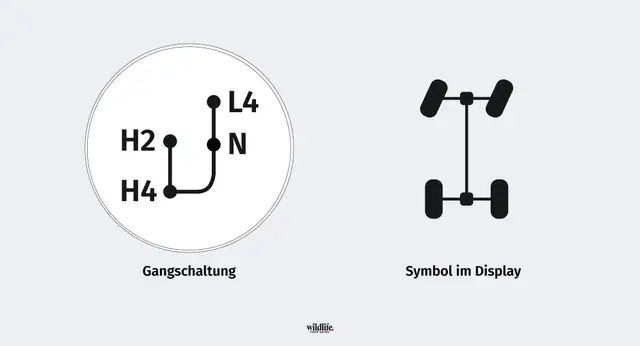
Most four-wheel drive hire cars in Namibia have a transmission with three main gears: H2, H4 and L4.
- H2 gear: The H2 gear (High Gear 2) is mainly used on tarmac roads. In this gear you get good fuel efficiency and higher speeds.
- H4 gear: When driving in deep sand, however, it’s important to switch to H4 (High Gear 4). The H4 gear improves traction and control, as the power is distributed evenly to all four wheels. Before you drive into deep sand, you should make sure you are in H4 in order to achieve optimum performance. The maximum speed is 80 km/h.
- L4 gear: There is one situation, however, in which H4 is not enough: driving in deep sand with extreme obstacles. In such cases you should switch to L4 (Low Gear 4). The L4 gear has been developed specifically for difficult terrain such as deep sand. It provides maximum torque and maximum power to overcome obstacles and maintain traction. Be sure to switch to L4 before you head into deep sand or cross water. The maximum speed is 40 km/h.
Shifting gears: Switching from H2 to H4 and L4
When switching between the different gears it is important that you stick to the order and have a bit of patience. Each gear has to be selected first and then engaged by the vehicle. Here is a step-by-step guide to shifting:
- Make sure that your vehicle is either in neutral or at a standstill.
- Find the gear lever in the centre console of your vehicle (H2, H4 and L4 are marked on it).
- To switch from H2 to H4, press the clutch all the way down and at the same time move the gear lever into the H4 position. A symbol will now start blinking in the display. If the gear has been successfully engaged, the light stops blinking.
- If you plan to drive in extremely deep sand or you simply can’t move on, you’ll need to shift further into L4. To do this, follow the same steps as before, but move the gear lever into the L4 position. The display will blink again until the gear has been successfully engaged.
- Always make sure the gear change is complete before you continue driving. A gear that hasn’t engaged properly can cause damage to the vehicle.
- If you now want to switch back to H4 or H2, simply follow the instructions step by step in reverse. So from L4 into H4 and then into H2. Always wait until the lights stop blinking and go out. Before you drive off, you should reverse for one metre to fully disengage the four-wheel drive function.
Driving techniques in deep sand: Speed and momentum
The speed at which you drive in deep sand plays a crucial role. It’s important that you maintain a slow and steady speed.
- If you drive too fast you can lose control of the vehicle or get stuck in the sand.
- A slow speed allows the tyres to maintain the necessary grip and dig through the sand instead of just throwing it up.
Another important aspect when driving in deep sand is maintaining momentum. If you keep your speed constant, the vehicle will “float” on the sand and is less likely to sink in. Avoid sudden steering movements to ensure stability and control. Be ready to turn the steering wheel slightly to avoid obstacles, but don’t overdo it. Your thumbs should always be on the outside so you don’t injure yourself in the event of sudden turns.
In addition to speed and momentum, there is another technique you can use when driving in deep sand: reducing tyre pressure. If you reduce the tyre pressure slightly, you increase the contact area of the tyres and improve traction. This allows the vehicle to move more easily through sand. However, make sure not to reduce the tyre pressure too much, as this can damage the tyres.
We have created a table with the recommended tyre pressure values. With these we drove through Chobe National Park in Botswana without any problems – and it really is very sandy:
- Tarmac road: 2.2 to 2.4 bar
- Tracks, corrugations, rocks (-15%): 1.8 to 2.0 bar
- Mud (-25%): 1.6 to 1.8 bar
- Deep sand (-50%): 1.0 to 1.4 bar (in extreme cases down to 0.6 bar)
Safety precautions: This equipment is our recommendation
Before you plunge into the adventure of driving in deep sand, it’s important to have the right equipment with you:
- Compressor: Without a compressor you can’t control the air pressure. You can let air out, but afterwards you can’t increase the pressure again. If there isn’t one included anyway, you should ask the hire car company for a compressor.
- Shovel: You should definitely have a shovel with you. If you get stuck, a shovel is probably the most important tool and, as far as we know, is included by all hire car companies.
- Sand ladders: These are not always included and can often be booked as an add-on. If you get stuck, sand ladders help the tyres regain traction. You won’t need them for Sossusvlei though.
- Tow rope: This is usually always included. Other vehicles can use it to pull you out of a sticky situation – or you can help others.
Conclusion: Confident off-road driving in Namibia’s deep sand
You now have a basic guide to driving in Namibia’s deep sand. If you understand the transmission system and choose the right gears, you can make the most of your off-road adventure. Remember that speed, momentum and the right tyre pressure are crucial to driving safely and successfully in deep sand. Don’t forget to take the necessary equipment with you.
To sum up, we can say that driving in deep sand always causes concern at first, but in the end it’s not that bad at all. Sossusvlei is no problem even for beginners. The Caprivi can be much sandier, but you should be able to handle that well too with the tips from this article. In any case, no one can take the experience away from you in the end.
Have lots of fun on your Namibia adventure!

Plan your trip in the app.
Save activities and places to stay, put your route together and take everything with you offline.