Translated from German. We write our content in German.Show original
Elephants: 10 facts you didn’t know about these animals

By Laura & Tobi ·
The elephants in Etosha were a very special experience for us. Today we know some facts we didn’t know before.
Even before we travelled to Namibia, I had one big wish: I really wanted to see African bush elephants in Etosha National Park. The animals are so huge and impressive, yet at the same time cautious, sensitive and social. We had already been able to read a lot about elephants beforehand. But through our journey we were able to learn much more about these wonderful animals.
Where are there still elephants at all?
Originally, around 20 million of the world’s largest land animals lived in Africa. Today there are still about 300,000 to 350,000 elephants. Poaching in particular takes a heavy toll on the animals, as does the loss of habitat.
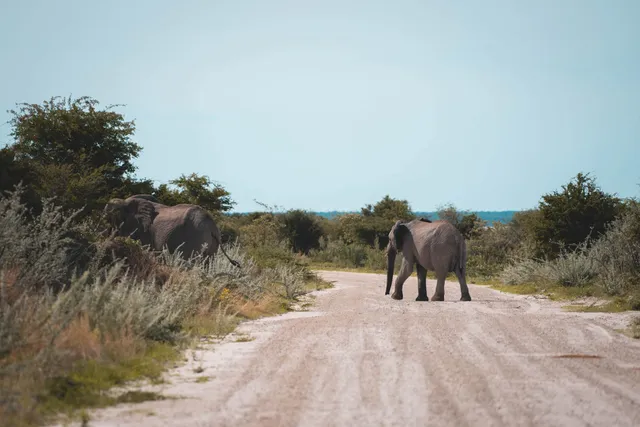
African bush elephants used to live mainly south of the Sahara – especially large numbers of elephants in Etosha National Park. However, as human settlement increases, the elephants’ original habitat is becoming more and more restricted. Arable farming and the building of settlements are shrinking their habitat and elephants are retreating mainly into forests, bushland and the savannahs of the national parks.
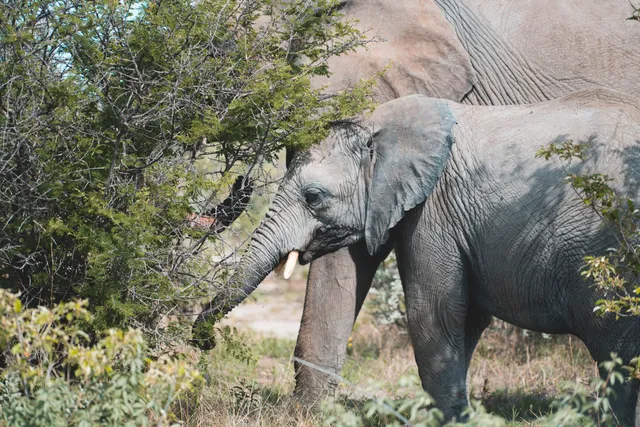
A similar development can be seen in Asian elephants. Their original range is increasingly fragmented by arable farming, settlements and human infrastructure. The number of elephants alive today is therefore concentrated in protected forest areas and adjacent grassland and bushland. Today you find Asian elephants mainly in Bangladesh, Bhutan, Cambodia, China, India, Indonesia, Laos, Malaysia, Myanmar, Nepal, Sri Lanka, Thailand and Vietnam.
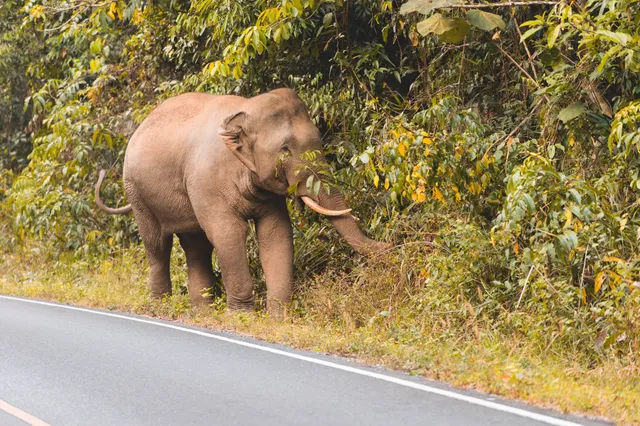
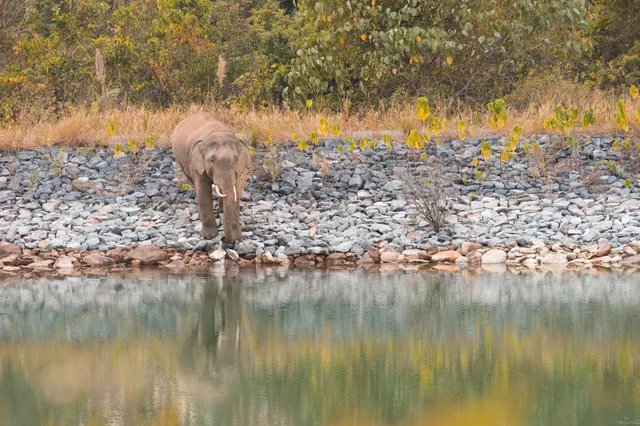
During our travels we were able to observe Asian elephants in Khao Yai National Park (Thailand) as well as a herd of African bush elephants in Etosha National Park (Namibia).
Elephants and the social network
African bush elephants, weighing around six tonnes and standing over three metres tall, are certainly not small animals. On the contrary: they are the largest land animals in the world. That elephants are intelligent, can even solve simple arithmetic problems and recognise themselves in a mirror may already be familiar to some. This is also because elephants, with their 257 million nerve cells in the brain, have roughly three times as many as humans.
Beyond that, elephants are also emotionally intelligent and maintain an extensive social network within the herd, which consists mainly of cows and calves and is led by a matriarch. The matriarch is usually the oldest female in the group, often no longer fertile and between 40 and 50 years old. Her main responsibility is to provide the herd with food and water. The herd’s migratory behaviour depends largely on the availability of food. During the rainy season the animals are more likely to stay in one area, while in dry regions they often wander over long distances to find food. The matriarch knows from experience exactly where food and water sources are and leads the herd along familiar “elephant paths” back to these places again and again.
Bulls, on the other hand, leave the herd after about 12 years and only join a herd during the rut. Outside this time they live alone or in loose groups made up of several bulls.
Elephants can get sunburnt
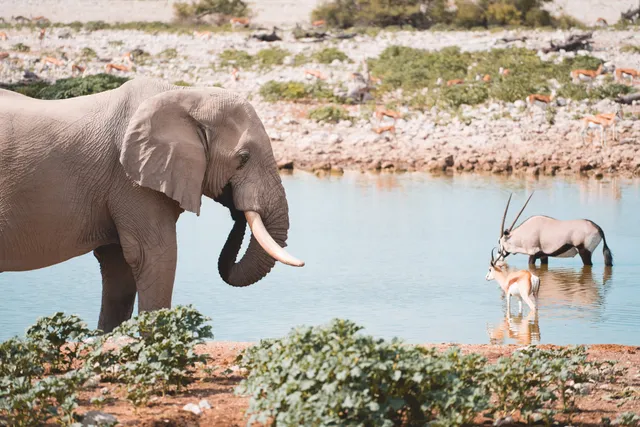
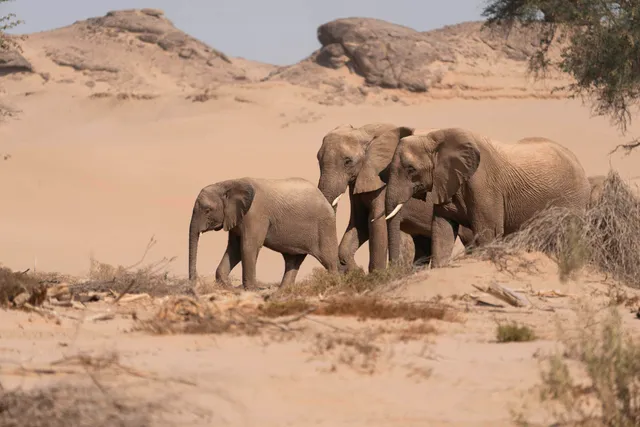
Even if you might not expect it, elephants can also get sunburnt. That is why you often see the animals throwing sand over their own backs and heads or wallowing in mud. A nice side effect is that insects find it harder to bother the large mammals. We were also able to observe this sun protection behaviour in the elephants in Etosha.
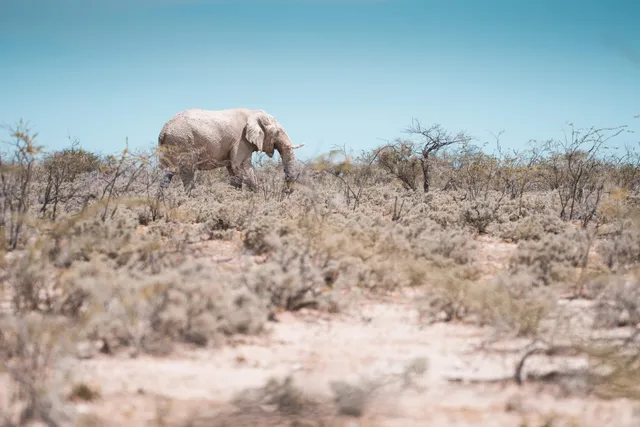
The older animals also help the youngsters to protect themselves from the sun. To do this, the little ones are driven through the sand until they are completely coated. When the elephant calves eventually get tired and fall asleep, the adults stand over them so that they are protected from the sun.
As well as sunburn, the animals also have to make sure they don’t overheat in the sun. They cannot sweat. However, their large ears help them regulate their blood temperature. When the ears are spread, the blood travels much further, away from the body, through the ears. In this way elephants manage to cool themselves down by up to 10 degrees.
Elephants can hear with their feet
Even though children are always being asked “what noise does the elephant make?” trumpeting is by no means the main way herd members communicate with one another. Actual vocal sounds are produced mainly to express emotions such as excitement, fear or aggression. To communicate within the group, two thirds of all communication consists of infrasonic sounds. These cannot be heard by humans and are transmitted through the air or the ground over many kilometres. In this way the animals can send messages to each other even when they are far apart.
With the elephants in Etosha we could also see how the animals seemed to communicate silently with one another – even when other elephants were out of sight behind a bush or a hill.
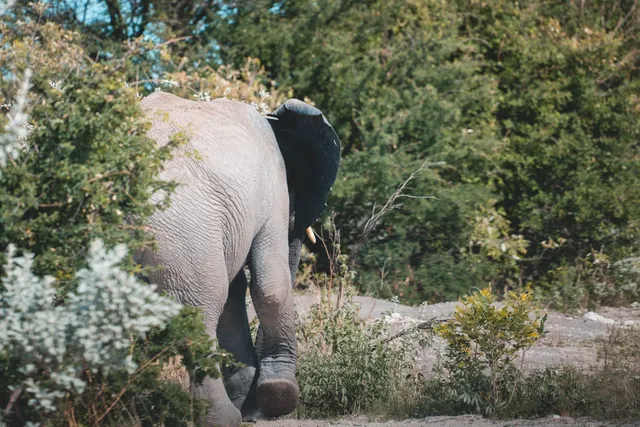
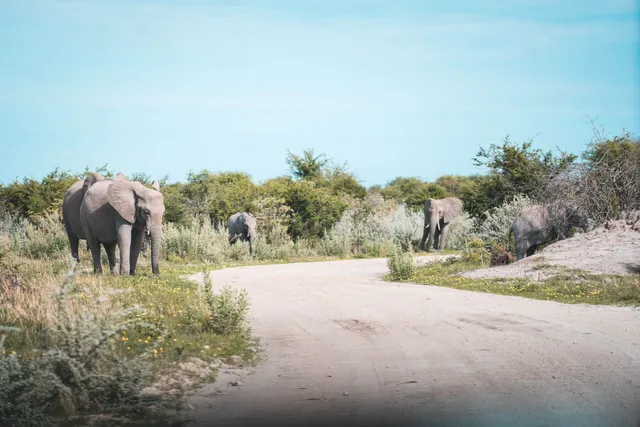
In general, audible noises from outside are very important for elephants in order to assess situations. For example, they can tell from a person’s voice whether that person might be dangerous to them or not.
The trunk is actually a snorkel
According to research, elephant embryos show a special kidney structure that is typical of aquatic animals. It is assumed that the ancestors of elephants lived exclusively in the water – similar to manatees today – and used their trunk mainly as a snorkel. Another indication of this is that elephants, unlike other land mammals, have internal testes.
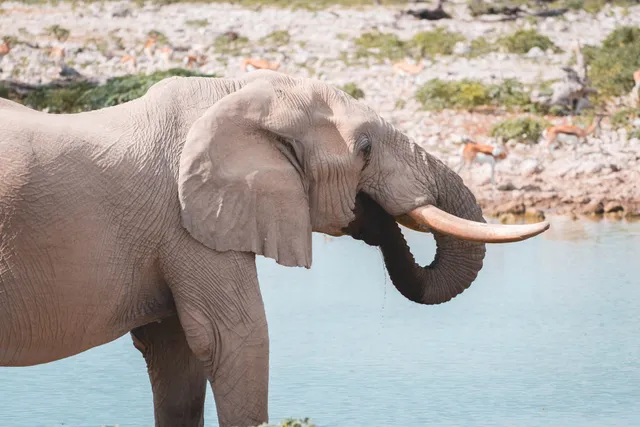
Whether or not this is true, today elephants still like to use their trunk as a snorkel when swimming.
Elephants feel grief and compassion
Elephants are huge, they like to push over trees and if you get too close they can become aggressive. Nevertheless, these mammals are quite sensitive. Elephants are able to identify a dead member of their own species by its tusks.
It has also been observed that when elephants lose family members they display similar rituals to humans. In Kenya, for example, it was observed how a mother animal in a family group had died. The entire herd then gathered around the dead animal and kept vigil by the body. They said their farewells and only moved on much later.
An elephant never forgets
You probably know the saying that people who can remember lots of things for a long time have “a memory like an elephant”. Even if we use it just as a saying, there is also some scientific truth in it. Elephants have particularly well-developed temporal lobes, which are responsible for storing memories in the brain. Altogether an elephant’s brain weighs about five kilograms, making it the largest brain of any land animal.
Elephants walk 80 km per night in search of food
Ever been on a diet and counted calories? Then you’ll probably feel better when you hear that elephants consume about 250,000 kilocalories every night. To achieve this they spend around 17 hours a day eating leaves, bark and branches. However, it has to be said that they also walk about 80 km to do so, and in the process they probably work off a large part of the calories straight away.
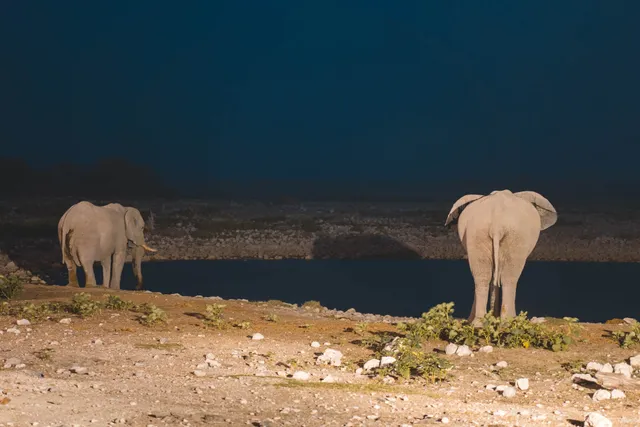
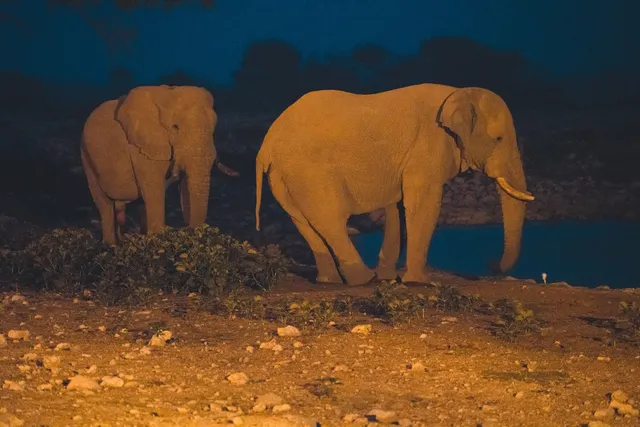
We were also able to observe these long walks in the elephants in Etosha. We spotted the animals on the horizon and followed their progress until they reached the waterhole. After they had topped up on water, they moved off again in a different direction.
Elephants walk on tiptoe
When elephants move, they always look a bit cumbersome at first glance. No wonder – there is quite a lot of weight resting on their feet. But what if the feet actually consist of individual toes or rather fingers? Strictly speaking, the animals are always walking on tiptoe and that is why, despite their weight, they move with such a light step.
Think about it: even a full-grown bull weighing around four tonnes leaves hardly any tracks in hard ground. That is why encounters with elephants are often quite surprising, because you only notice them once you actually see them.
Female elephants are midwives and nursery teachers
Did you know that the pregnancy of an elephant is the longest of all mammals? A female elephant is pregnant for around 22 months in total. At birth the little rascal already weighs a hefty 100 kilograms. That must be quite an impact when the baby drops to the ground from a height of around 70 cm.
Elephants work so well as a herd because everyone is there for everyone else. Female elephants therefore often take care of looking after the young and make sure that no animal strays too far from the group or is put in danger by wild animals while the rest of the group goes off in search of food.
Frustrated bulls push trees over
It really can be frustrating if you do not manage to find a partner. Bull elephants take the whole thing a bit more theatrically, as they also like to simply push over a few trees when the frustration gets too much. We could often tell where a bull elephant had probably passed by, because that was exactly where many trees lay snapped off, still covered in juicy leaves.
Have you ever experienced elephants up close and been able to witness one of these special elephant facts for yourself? Tell us about it in the comments!

Plan your trip in the app.
Save activities and places to stay, put your route together and take everything with you offline.