Cette page n’existe pas encore en français : nous te montrons la version disponible.
Interview: When I looked deep into an orca's eyes

Par Laura & Tobi ·
In an interview with Sinead, an orca guide on Vancouver Island, we find out what life in an orca camp is really like.
We met Sinead in September 2018 on Vancouver Island, when we wanted to go kayaking with orcas while staying at a camp. Since 2012 she has been drawn again and again to the beautiful west coast of the USA and Canada.
This summer she came to Canada for six months of work and travel – also to be closer to her passion, the orcas.
Hej Sid, why are you so fascinated by orcas?
You probably have to experience it yourself, seeing whales in the wild and undisturbed in their natural environment. In that moment when I am out at sea, in absolute silence and suddenly, out of nowhere, a whale appears, breaks the surface of the water and the only thing you can hear for kilometres is its breath – that is when the world stops for me.
"If I had to name one thing that I find most impressive about them, it would be their seemingly boundless empathy and willingness to help one another."
Orcas are my absolute passion. They have strong family structures, like we do, and they are incredibly intelligent.
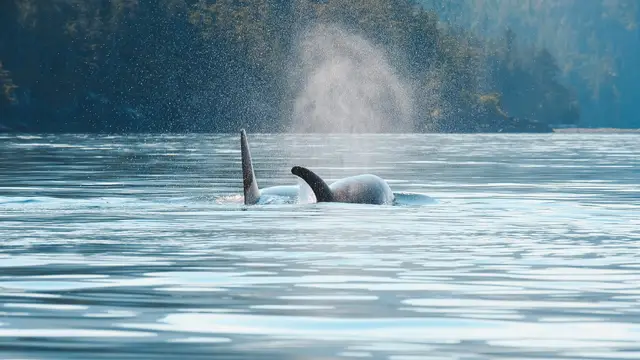
If I had to name one thing that I find most impressive about them, it would be their seemingly boundless empathy and willingness to help one another – because I think we could still take a leaf out of their book in that respect.
You are so right. Where does your passion for whales come from?
My dad always says that he must have sparked my fascination for orcas back when he showed me the film "Free Willy" as a child. He is probably not entirely wrong. I have loved orcas for as long as I can remember. But to see them once in the wild, I thought that would remain just a dream for ever…
…and then you did get to see them after all.
One of my first big trips took me to California in 2012, where on my first whale watching tour in Monterey I saw whales from a distance – grey whales, to be precise. The fire was lit. There had to be a way to see orcas. Somewhere in the world. And this wish took me back to the west coast in 2014. This time to Vancouver. The surroundings were the perfect starting point and are one of the best places in the world to see orcas in the wild.
"That moment, that tour, changed me for ever. Orcas became an addiction."
I still remember exactly what it was like to see them for the first time back then. The boat's engine was switched off, we were told orcas were heading towards us. Everything was quiet. And suddenly a female orca with her baby at her side broke the silence as the two surfaced not far from the boat.
The tour was incredible. I saw around 15 killer whales regularly breaching and putting on an amazing show for me. A show that only the wilderness could offer. That moment, that tour, changed me for ever. Orcas became an addiction. Two years later, before my first trip to Vancouver Island, I had my first tattoo done as a memento of 2014. No surprise: an orca!
We met you at the orca camp. How did it come about that you spent your summer there?
During my trip on Vancouver Island I spent 4 days as a guest in an orca camp. The aim was to go kayaking with orcas and humpback whales. Unfortunately without success. But I did see them every day from the boat or from the beach. What a paradise!
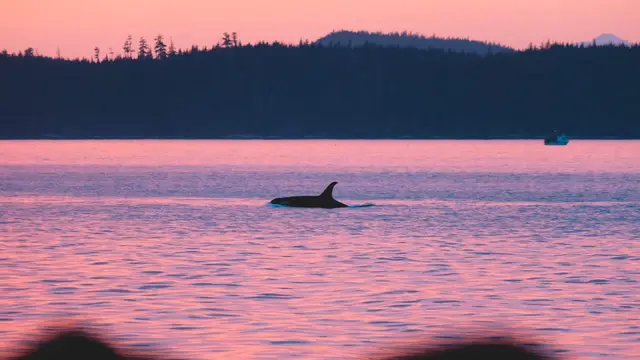
And a new dream was born: to work in an orca camp and spend a year in Canada with a work and travel visa!
Right, one step at a time. So you had been carrying this dream around with you for quite some time. And at some point you decided to make this dream come true on your own?
In 2018 I packed my things and set off alone to Canada for six months to make my dream come true. I will honestly admit: I am a very spontaneous person. I did little advance planning for these six months. Of course there were a few things to sort out at home: fortunately my employment contract was put on hold and I was able to sublet my flat. The main goal was the orca camp. Everything else would fall into place over time.
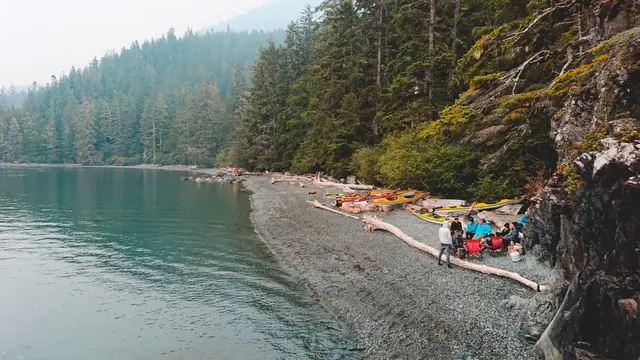
To my great fortune I was given the chance to work for the entire summer season from July to September at the truly unique orca camp run by Ecosummer Expeditions, supporting the main guides.
Wow, so that's how it can go. You have this wish that just won't let you go. And suddenly it all becomes reality. So what did a typical day in the orca camp look like?
A normal day in camp began at 7am in our rustic but fully equipped outdoor kitchen. There we prepared breakfast for our guests to set them up for the full-day kayak trip.
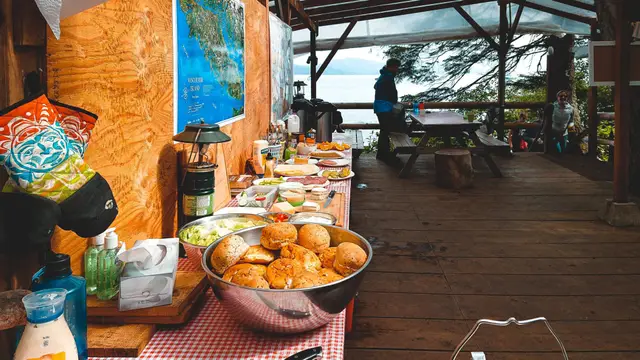
By 10am at the latest we headed out to sea – always on the lookout for orcas and humpback whales.
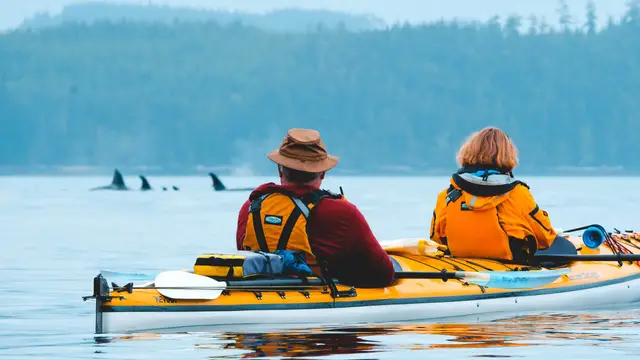
When a steamer occasionally passed through the Johnstone Strait it always felt strange. After all, you usually spend the whole day alone out on the sea. It is an indescribable feeling, cut off from everything. Like being in your own little world. A world that, thanks to the camp's ideal location next to the Robson Bight nature reserve, could not be better for watching orcas even from the beach.
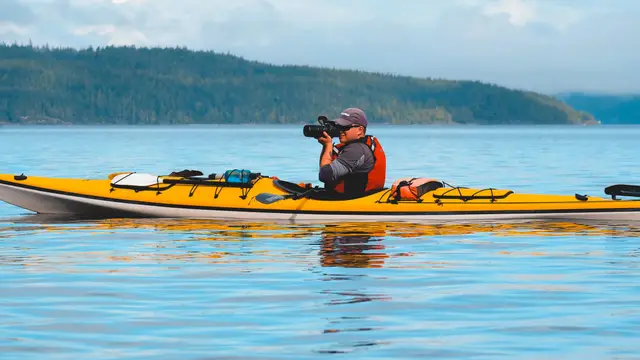
In the kayak we keep to the new safety distance of 200m from orcas, introduced in July 2018, to protect them and give them enough space to search for food.
Many people are probably now wondering whether it isn't completely crazy to go kayaking where "killer whales" are about…
We ourselves are not on the menu. Orcas detect us via their echolocation and are aware of our presence at all times.
"Orcas have never attacked a human in the wild."
By this point my family already thought I was crazy. How can you expose yourself to such danger? But orcas have never attacked a human in the wild.
But your heart must still be pounding, right?
I didn't feel any fear at all – but I do think my heart skipped a few beats when, despite us keeping to the safety distance, an orca suddenly changed course and surfaced right next to my kayak.
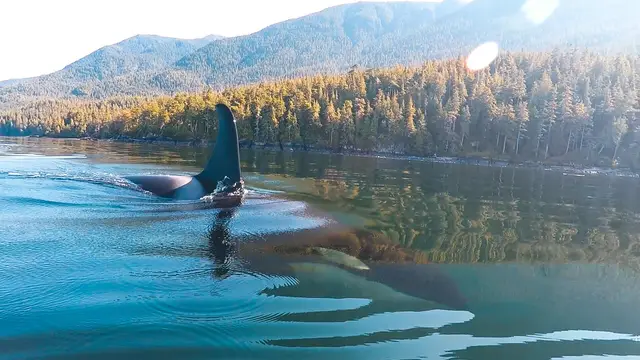
If someone asks me about my highlight in Canada, it was that moment when I was able to look this orca directly in the eyes. That moment that I had never thought possible.
Lovely. That sounds very moving. Looking back now, what is it that makes this time at the camp – apart from this wonderful encounter – so special for you?
There were also these surreal moments from our beach, for example when a group of about 15–20 orcas passed by not even 5m away and took everyone's breath away.
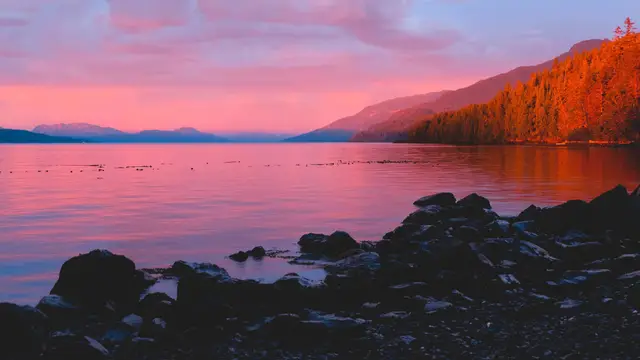
Or a humpback whale that slept right in our little bay and whose breathing you could hear all night long, even from the tent.
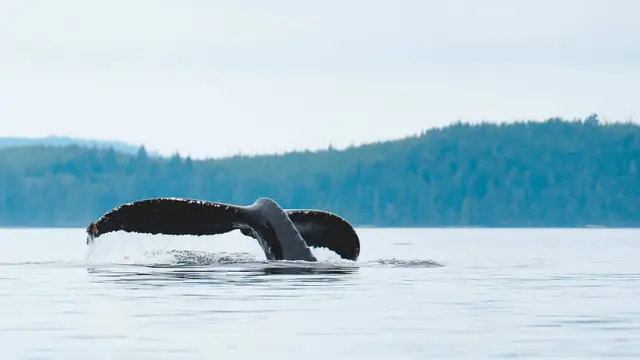
In summer the sea glows with varying intensity thanks to bioluminescent plankton and on clear nights you get an incredible view of the Milky Way. In the mornings I was often woken by orcas passing along the beach.
"I spent the whole summer right by the sea, camping in a part of Vancouver Island that was completely cut off from the outside world."
I spent the whole summer right by the sea, camping in a part of Vancouver Island that was completely cut off from the outside world and our only neighbour for miles around was an American black bear.
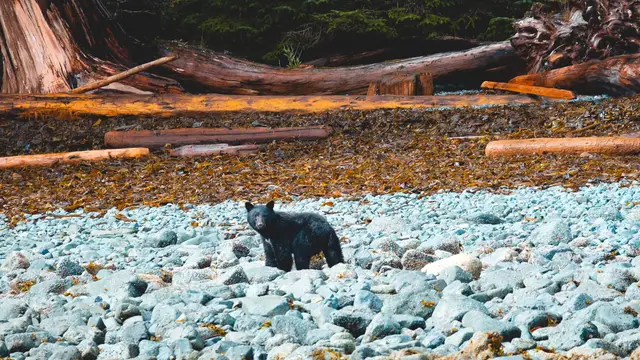
All that could only have been a dream, right? But it was real. And it was the best summer of my life with the best colleagues you could imagine.
Wow, what an amazing time! You’ll probably never forget these moments for as long as you live. We’re so happy that you were able to make your dream come true. But tell us, something we’ve always really wondered: how do the locals actually feel about whale tourism and fishing?
The small town of Port McNeill, where I spent my days off, lives from whale tourism and everyone there loves whales. The community and the supposedly competing companies help each other out and even share information over a joint radio channel about who has seen whales where and when – something I found incredibly positive during my time there. Maybe it’s also because Canadians are simply the nicest people in the world.
"The locals are aware that one of the biggest dangers for these animals is starving. Everyone is glad when commercial fishing is stopped again."
Every one of the tour operators sticks to the safety distances. However I can’t say the same about the fishing boats. I often saw them driving right through a passing group of orcas and casting their nets, which are especially dangerous for humpback whales, as unlike orcas they don’t use echolocation. The locals are aware that one of the biggest dangers for these animals is starving. Everyone is glad when commercial fishing is stopped again.
Personally, I found it shocking how much plastic rubbish we found in the sea from the kayak once the fishing boats started docking in the Johnstone Strait.
Commercial fishing is unfortunately a problem everywhere, and particularly in the Johnstone Strait. But it’s good to hear that you would see whale tourism as largely respectful. When, where and how can whales be especially well observed around Vancouver Island?
The orca season on the northern east coast of Vancouver Island runs from around the beginning of July to around the end of September. Humpback whales are usually already in the Johnstone Strait from May but move further and further into the Broughton Archipelago from the end of August. If you’re really keen to see whales you have one of the best chances in the world here.
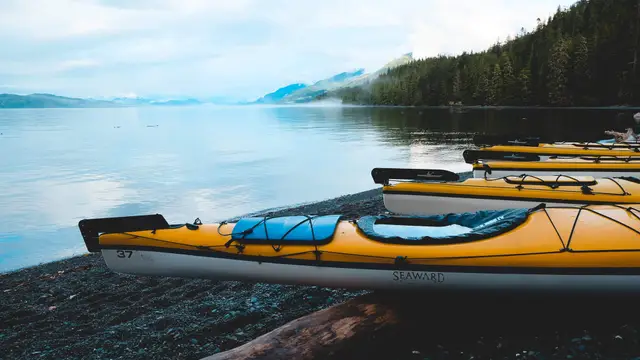
I can warmly recommend either a multi-day kayaking-and-camping tour with Ecosummer Expeditions or Mackay Whale Watching in Port McNeill for the best day trips. In the south of the island around Victoria it’s also possible to see orcas in spring and autumn. Here the best options are Ocean EcoVentures or Eagle Wing. On the west coast around Tofino the chances of seeing orcas are rather lower. You’ll encounter humpback whales and grey whales more often here.
Those are great tips for whale watching. If you decide on a tour by kayak, what’s best to pack?
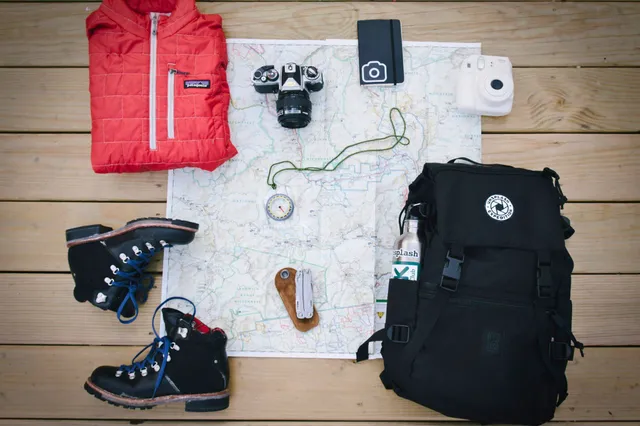
The weather in the north of Vancouver Island can change quickly, so you have to be prepared for everything. A sensible choice would be a waterproof jacket, a thin jumper and a T-shirt so you have more options. Don’t use cotton under any circumstances, as it just dries badly.
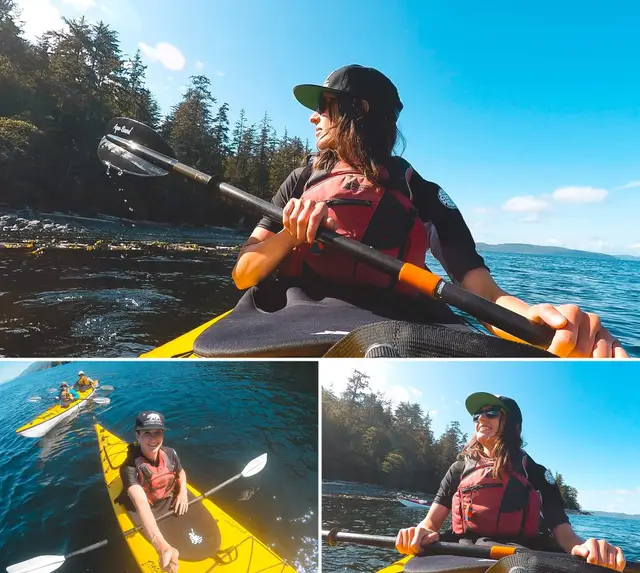
Personally, I always wear short sports shorts, as your legs get wet anyway. Otherwise, long sports trousers or even thermal underwear are recommended for very cool days. In addition you’ll need sturdy water shoes, and ideally not flip-flops.
Sun cream, a cap and sunglasses are important if you’re paddling out at sea in the sun all day. Binoculars never hurt. A waterproof bag protects your cameras and spare clothes. On multi-day camping trips combined with kayaking it’s also always important to have a dry, warm set of clothes for the evening.
Great tips! And now for the most important question: when are you heading back to Canada?
My time in Canada changed me and I wanted to capture that forever with a humpback whale tattoo to go with my orca. Not a day goes by when I don’t feel the pull to go back. So it’s probably no surprise that I’m already deep into planning my next summer on Vancouver Island.
Then we’d like to wish you an amazing new adventure on Vancouver Island already!
—
Many thanks, Sid. Your story is truly impressive and has given us a deep insight. Thanks as well for all your tips. We’ll stay in touch!
Do you have any questions for Sid or were you captivated by her story? Then write to her in the comments.
PS: Has the adventure in an orca camp captivated you? Then have a read of our article where we write about how we wanted to go kayaking with orcas.
This post has to be labelled as advertising – even though we were neither asked to do so nor paid for it.
Crédits photo : Titel: Alice Donovan Rouse
Pour aller plus loin
Planifie ton voyage dans l’app.
Enregistre activités et hébergements, compose ton itinéraire et emporte tout hors ligne.