Cette page n’existe pas encore en français : nous te montrons la version disponible.
Kayaking with orcas off Vancouver Island
Par Laura & Tobi ·
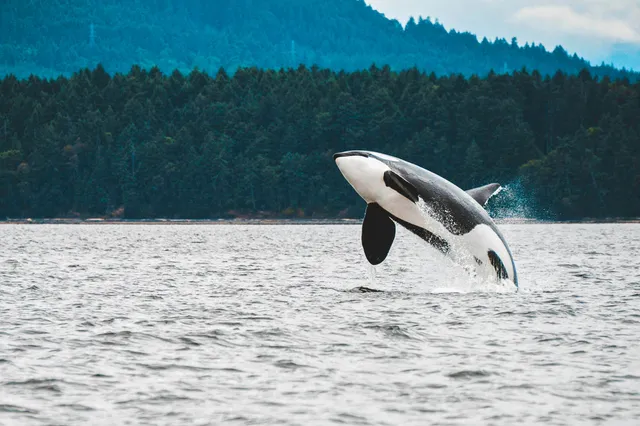
You’d love to go kayaking with orcas yourself? Then we’d like to tell you about our experience off Vancouver Island.
Kayaking with orcas has to be a huge adventure. Just us, the kayak and the orcas. Totally fascinated by the fact that you can even book this kind of trip, we signed up for the adventure off Vancouver Island. At the beginning of September it was finally meant to happen. The big wilderness adventure, a camp in the rainforest and, of course, kayaking with orcas could finally begin. In this article we want to tell you about our experiences.
Why we want to kayak with orcas
Whales and orcas have a very special fascination for us and probably for you too. Straight away we have to think of "Free Willy" and of orcas in amusement parks with that typically curved dorsal fin. For the orcas this means a life in captivity, shut away in a concrete pool. How wonderful it must be by contrast to see these graceful animals free in their natural habitat. We associate orcas and whales with a strong feeling of freedom. Before our trip we read a lot about orcas and especially quite a bit about orcas in captivity, such as Corky’s story. The stories of the individual orcas move us deeply and so the wish to observe the animals without disturbing them grows ever stronger.
Just imagine lying in your tent at night, listening to the sounds in the darkness. Suddenly you hear the breathing of humpback whales or orcas as they exhale and blow the air out in a spout.
At least that was our idea. The reality then turned out to be quite different and we ended up putting up with three days of rain and stormy weather, which we certainly hadn’t hoped for. But one thing at a time…
Getting to the orca camp
Our adventure starts in Port McNeill, a small town in the north of Vancouver Island. More precisely, at the Haida Way Motor Inn. On the evening of our arrival we have a briefing there with the other participants and our two guides. It quickly turns out that the group is made up mainly of Germans. In total we are four German couples and one Canadian couple. Everyone seems very friendly and so Tobi and I head off for something to eat, full of anticipation for the days ahead.
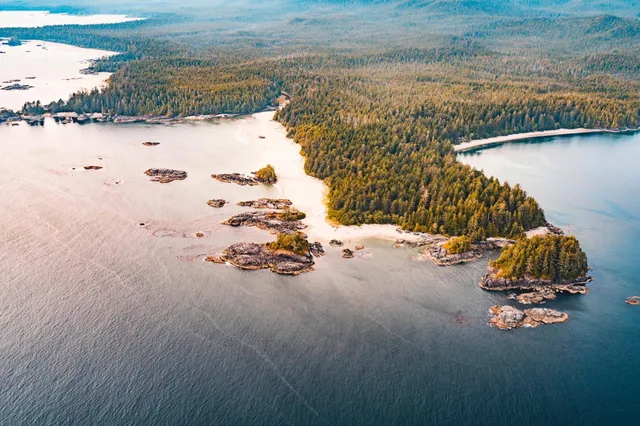
The next morning we meet early at the hotel entrance. The clouds cover the sky and it looks like rain. We don’t think much of it yet. Our group and our luggage are taken to the harbour by taxi. From there we continue by water taxi along the Johnstone Strait. To our left and right we see the forested coast, with hills and mountains rising up behind.
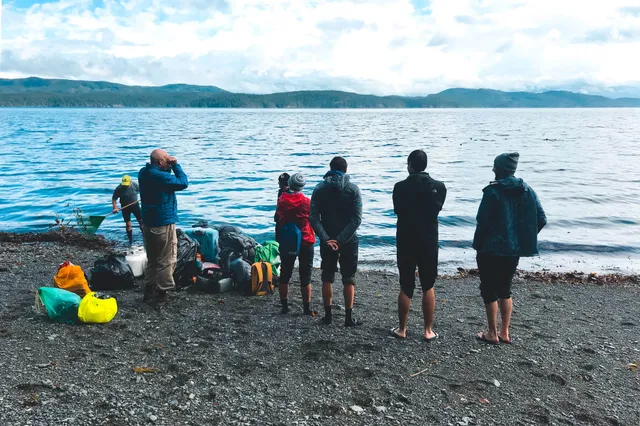
After an hour we reach the camp. Unloading our luggage and the supplies for our stay has to be done quickly. Because of the waves the water taxi cannot stay for long in the shallow water. We manage the task quickly as a team and everyone lends a hand.
The orca camp
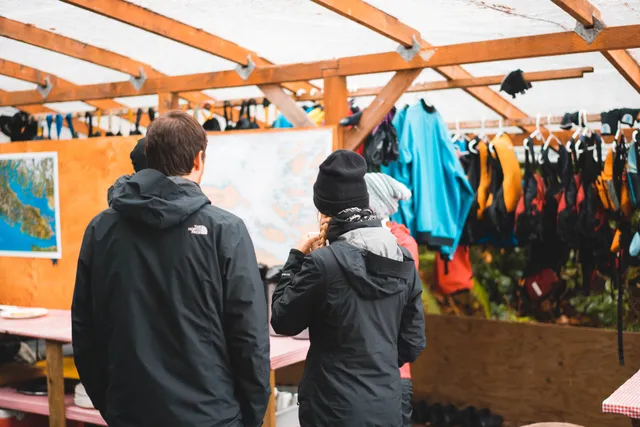
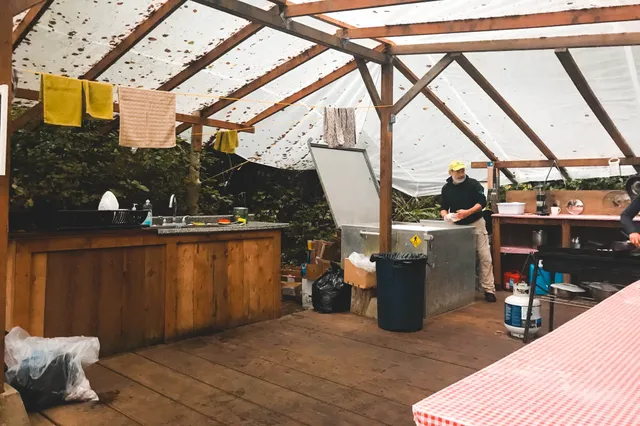
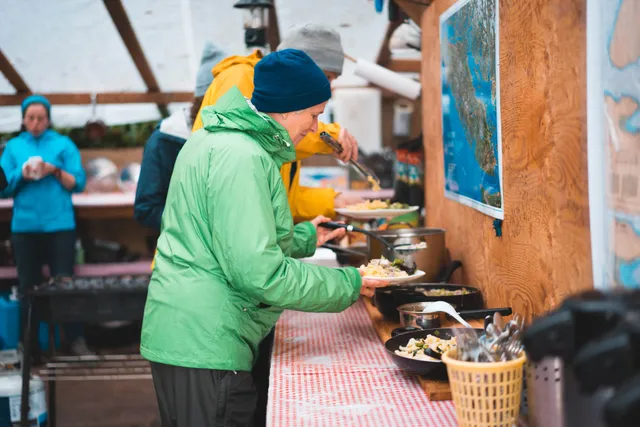
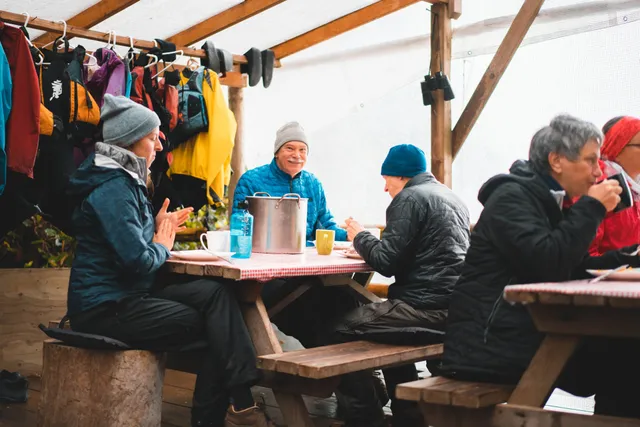
The camp is really nicely set up, perfect for spending a few days here. There is a large camp kitchen with tables and benches. This is where everything happens on rainy days and it is also where the kayak equipment hangs. Maps of the region with its countless small islands hang on the walls.
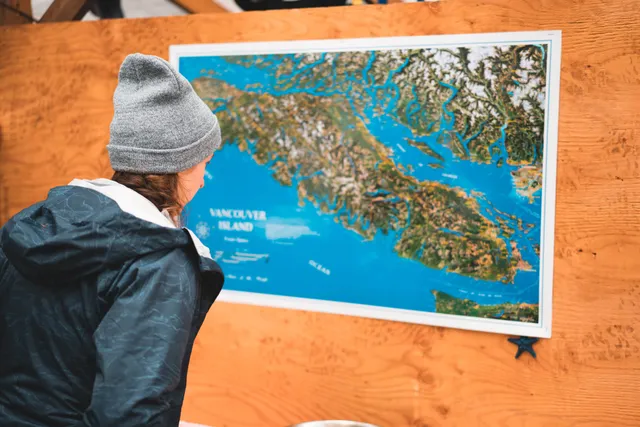
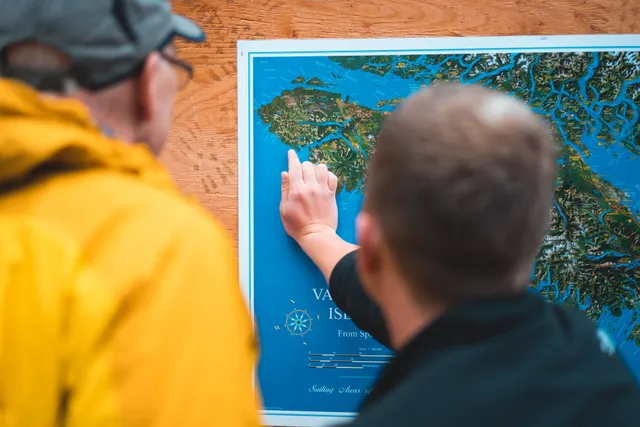
A path leads from the camp kitchen further into the camp. We pass compost toilets and showers. The wooden-built showers are very spacious and attractive. Because of the weather only one person in our group actually tries them out. Nobody else wants to take off their warm clothes under any circumstances.
The path winds into the rainforest. Ferns and other plants grow densely together and we have the feeling of being deep in the undergrowth. To reach the tents you cross a few stones lying in a small river. The river water is drinking quality and we can fill our bottles with fresh water there every day. Over a small bridge and then we reach the tents. All the tents stand on platforms scattered in the rainforest. The tents offer enough space for the two of us and our rucksacks.
It’s too stormy, we can’t kayak
Once everyone has arrived we are eager to find out when we can finally get out on the water. It quickly becomes clear though that the waves are getting stronger rather than weaker. The swell seems too strong to our experienced guides and so we won’t be kayaking with orcas today. That’s a real shame. But it does mean we can explore the beach at the camp a bit.
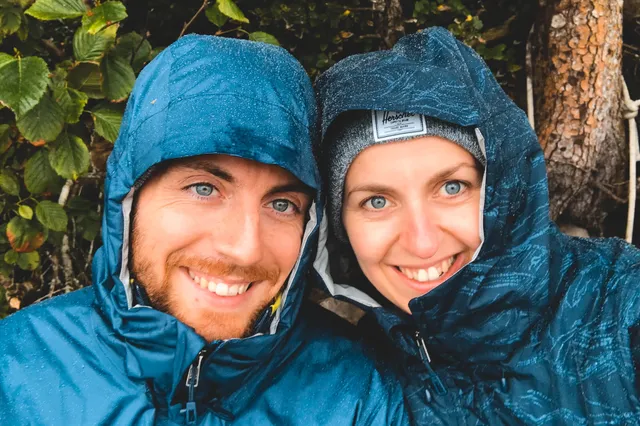
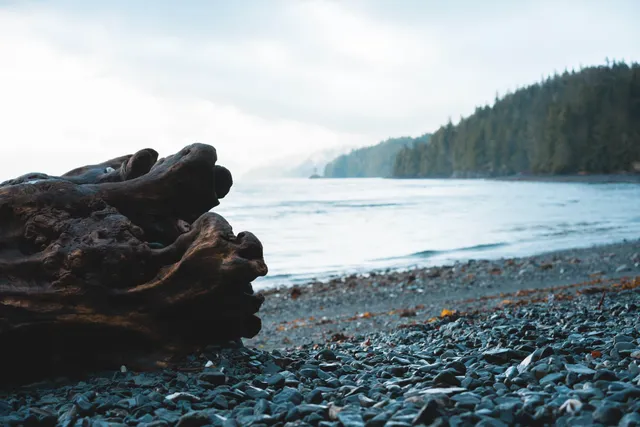
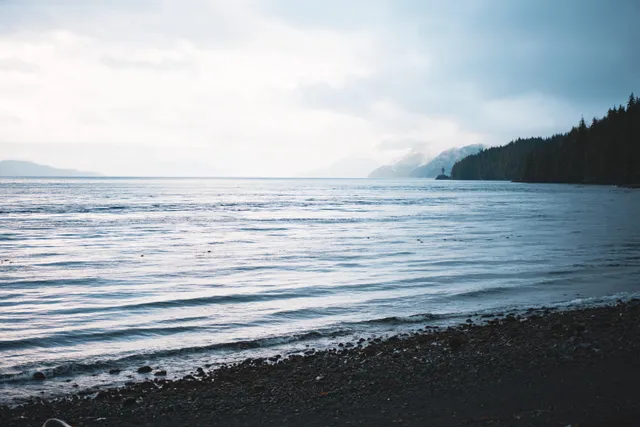
All along the shore there is driftwood and huge tree trunks. When it starts to rain we pull our hoods further down over our faces, sit down on one of the trunks under a few trees and watch the waves. Here we sit, far away from the nearest town. In front of us lies the Johnstone Strait, an intact habitat for many marine animals, and behind us the rainforest.
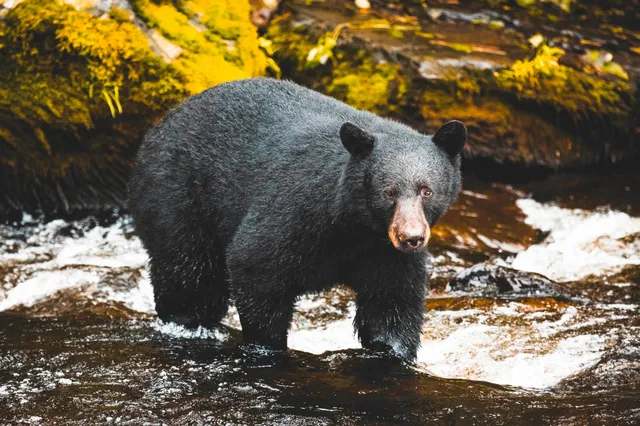
Our guide Jordan tells us that from time to time an American black bear, who has been given the name Jasper, visits the beach in front of the camp. He has never shown up by the tents so far. It would be amazing to spot him from a safe distance! The rain gets heavier and pulls us out of our thoughts. It is getting a bit too wet for us and we retreat to the camp kitchen.
The rest of the day in camp
So that we don’t spend the afternoon just sitting around, we all try on our kayak gear. Everyone gets a life jacket, a waterproof jacket for kayaking if needed, and a spray deck. The spray deck is worn like a skirt and then, once you are sitting in the kayak, pulled over the cockpit. This keeps any spray from getting in and an added bonus is that the temperature around your feet stays pleasantly warm.
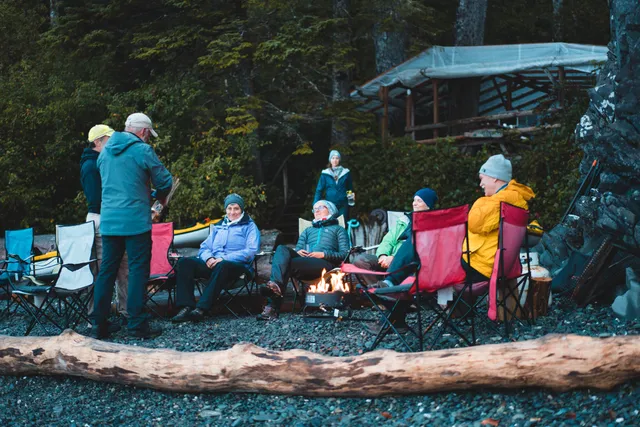
The rest of the evening is spent enjoying a tasty and convivial meal. The camp crew conjures up really delicious food at all times of day! Even though the weather doesn’t exactly show its best side, after dinner we head down to the beach and all sit around the campfire. It just has to be done! Dessert is served and as it slowly gets dark our guides tell us stories about whales and orcas. The evenings around the campfire are some of the very best moments! When it gets too cold and we start to feel tired we go to bed at 9pm.
Finally on the water – will we kayak with orcas?
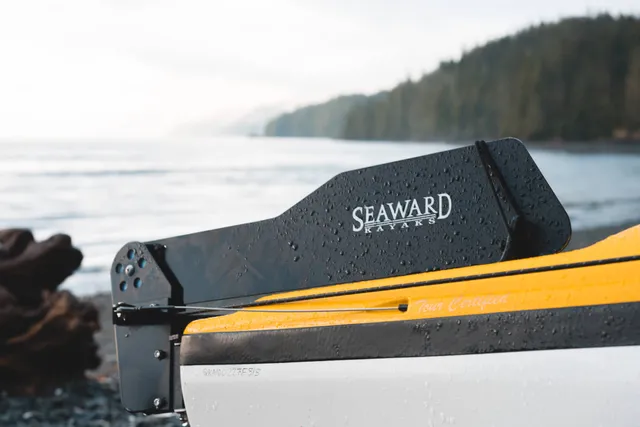
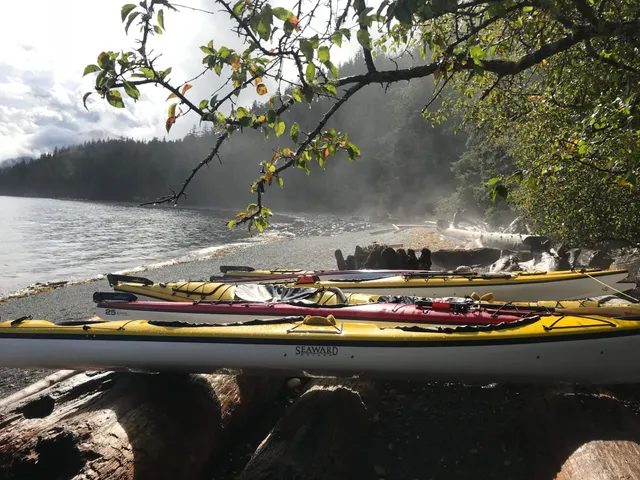
The second day begins with the announcement that this morning we can finally go kayaking. After breakfast we pull on our kayak clothes, put on our life jackets and, in the drizzle, carry the kayaks down to the water. Once we are all sitting in our double kayaks we paddle along the coast. Our guides constantly check the whale channel on their walkie-talkies and therefore have a pretty good idea where the different orca groups are. Humpback whales, however, can surface quite suddenly at any time and in any place. Even though we all know that the orcas are not in the immediate vicinity, we are still excited to discover the area from the water.
Tobi and I are sitting in a sea kayak for the first time and quickly get the hang of it. Jordan paddles in front, followed by our group, and bringing up the rear are our guide Steven and our cook Heather. We stop a few times and take short breaks on the water. The drizzle has actually stopped and we see a bald eagle flying overhead. Along the rocky coast we keep an eye out for starfish and harbour seals. We are in luck with the harbour seals and spot two animals that repeatedly appear at the surface.
After two hours we return to our camp and spend the rest of the day much like yesterday.
Where are the whales?
The second day also ends without any special orca or whale sighting. It really is a pity and of course we are all a bit down about it. Via the whale channel we hear that the orcas are hardly moving away from their bay. We are torn. On the one hand we don't want to give up hope of seeing whales, on the other hand the weather seems to be throwing a spanner in the works. It is getting stormy again and even from the beach it is difficult to spot animals such as harbour seals or humpback whales at the surface of the water. The day passes in camp without us seeing a single animal.
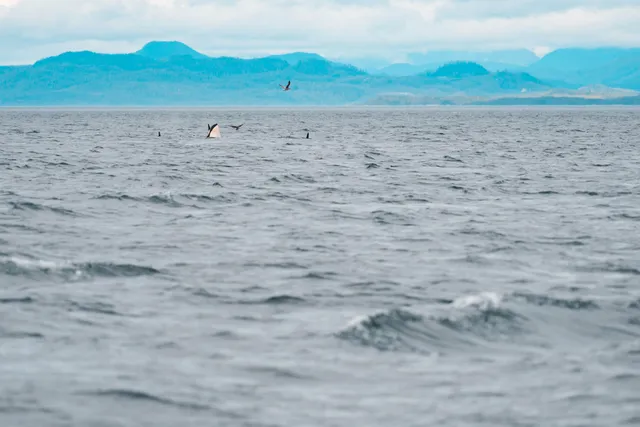
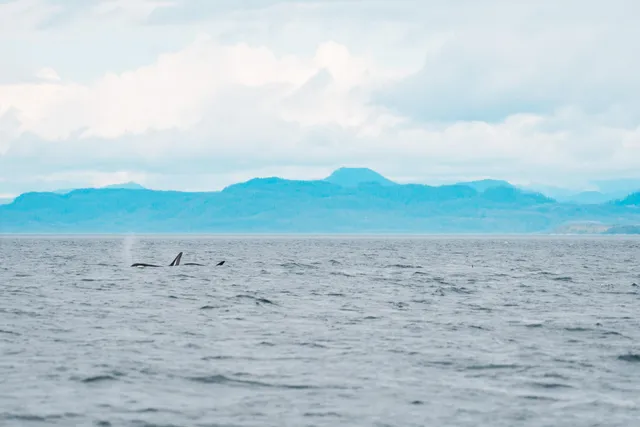
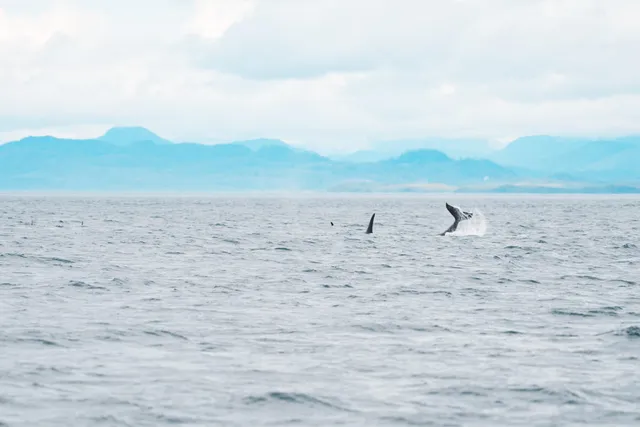
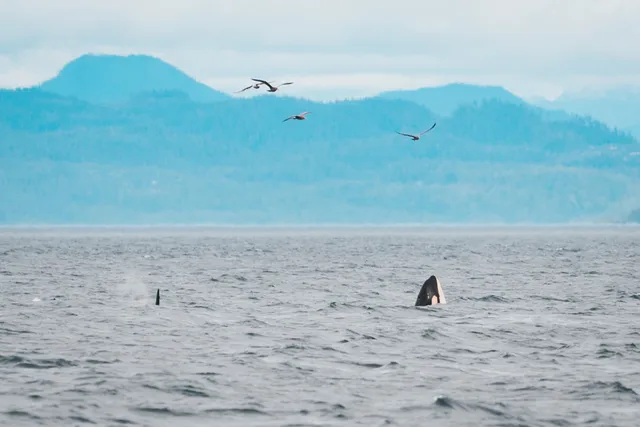
On our last day – departure day – we have a bit of luck after all. When we are picked up by our water taxi and taken back to Port McNeill, our driver hears that there is a group of orcas nearby. He does us all a huge favour and stops the small boat. The group of orcas is very far away, but we can still clearly make out that they really are orcas. The dorsal fins keep appearing over and over again. It is really beautiful! After a few minutes, though, we have to continue back to the harbour.
Sometimes you are lucky, sometimes you are not – our conclusion
Before we signed up for the orca camp we made it clear to ourselves that there was no guarantee of whale sightings. We were aware that we would be in the midst of magnificent nature and that you can't influence how the whales move. With this attitude we travelled to Vancouver Island. Luckily! That way, of course it was still a real shame and yes, we were a bit disappointed too, but we avoided major frustration. Despite the stormy weather we were able to appreciate the special charm of the camp and really enjoyed the experience of being out there in nature.
We particularly want to highlight that our operator, Ecosummer Expeditions, got in touch with us after our trip, as they had already heard about our bad luck. They offered us the chance to join a whale watching tour to have another opportunity to see orcas. We took up this offer in Campbell River. Unfortunately, we didn't see any orcas on this tour either. It seems as if it simply wasn't meant to be and that we'll have to come back again. And there is nothing we would rather do!
Packing list – what should you take with you?
Before our trip we spent a long time thinking about what we would really need to go kayaking with orcas. Now, after our trip, we are wiser and know what proved itself and what is genuinely practical.
We would like to help you and have put together a packing list of clothing and equipment. Here we go:
- Water sandals or neoprene socks: when getting off the water taxi and also when getting into the kayak you can't avoid standing in water up to your calves. On the rocky ground you move more safely if you are not barefoot. Definitely recommended in cooler temperatures too.
- Shoes: comfortable shoes with grip for the camp
- Woolly hat and cap
- Sunglasses
- Sports shirts: short- and long-sleeved versions made of quick-drying material are practical
- T-shirts
- Fleece jacket: for women / for men
- Long-sleeved top: a warming layer that keeps you warm day and night. For women / for men
- Waterproof jacket and trousers: the jacket (women / men) and trousers (women / men) should be more than just water-repellent.
- Insulated jacket: women / men
- Shorts: when you get into the kayak your trousers quickly get a bit wet, so it is practical if the material dries quickly. After kayaking you swap the shorts for a dry pair of trousers.
- Trousers: we wore jeans in camp, but if they get wet they dry very slowly.
- Water bottle with carabiner: you can use the carabiner to attach the bottle to the kayak.
- Sun cream
- First aid kit and essential medication
- Toiletries
- Microfibre towel
- Head torch and extra batteries
- Drybag: to protect your camera from spray.
- Binoculars
- Drinks for the evening campfire and your favourite snacks
Our tip: Make sure you take clothes you can wear in layers like an onion!
Note: We paid for the orca camp ourselves.
Extra tip: By the way, if you ever want to watch orcas comfortably from home, have a look at this live stream.
Tell us in the comments whether you have already had the great good fortune to see whales or whether the experience is still on your bucket list!
Pour aller plus loin
Commentaires
Fräulein Snöflinga
octobre 2018
Oh yes, I’d have one or two stories to tell about whale watching as well. It also took me a few attempts in Iceland and South Africa before I finally got lucky. In the end it worked out in northern Norway in Andenes, even with orcas! And the Azores are also great for whale watching. Best, Nadine!
Traduit automatiquementVoir l’original
Ach ja, zum Thema Whale Watching hätte ich auch die eine oder andere Geschichte zu erzählen. Ich habe auch ein paar Anläufe in Island und Südafrika gebraucht, bis ich endlich einmal Glück hatte. Geklappt hat es letztendlich in Nordnorwegen in Andenes, sogar mit Orcas! Und die Azoren sind auch super für Whale Watching. Gruß, Nadine!
Laura & Tobi von Wildlife Tour Guide
octobre 2018
Hi Nadine, so great that after a few attempts it finally worked out in Norway! It’s just wonderful to be able to watch the animals here in Europe too! Best wishes, Tobi and Laura
Traduit automatiquementVoir l’original
Hi Nadine, super, dass es nach ein paar Anläufen endlich in Norwegen geklappt hat! Einfach toll die Tiere auch hier in Europa, beobachten zu können! Liebe Grüße, Tobi & Laura
Anna und Michael
octobre 2018
Wonderfully written, the article was great fun to read. Nature doesn’t give any guarantees and yet you still hope. This time we were lucky in Iceland, but we were unlucky once in Portugal too. It’s lovely that you still wrote so well about the region. The thing with the camp is exciting. We’re looking forward to more …
Traduit automatiquementVoir l’original
Toll geschrieben, hat super Spaß gemacht der Artikel. Die Natur gibt keine Garantie und dennoch hofft man. Wir hatten dieses Mal Glück in Island. Aber hatten auch mal Pech in Portugal. Schön das ihr trotzdem so toll über die Region geschrieben habt. Spannend mit dem Camp. Freuen uns auf mehr …
Laura & Tobi von Wildlife Tour Guide
octobre 2018
Hey Anna and Michi, great that you were lucky in Iceland! You really always need a bit of luck. But that’s exactly what somehow makes it so exciting and special 🙂 Best wishes, Tobi & Laura
Traduit automatiquementVoir l’original
Hey Anna und Michi, toll, dass ihr Glück auf Island hattet! Es gehört wirklich immer eine Portion Glück dazu. Aber genau das, macht es ja auch irgendwie so spannend und besonders 🙂 Liebe Grüße, Tobi & Laura
Siegfried
octobre 2018
So exciting and interestingly told that you feel as if you’d been there yourself! Please keep it up!
Traduit automatiquementVoir l’original
Also so spannend und interessant berichtet das man Gefühl hat dabei gewesen zu sein! Weiter so bitte!
Siegfried
octobre 2018
Interesting that so many fellow countrymen were there with you! Your report was once again written so interestingly that you could savour it as if it were your own experience! Unfortunately we can no longer undertake trips like that, but we enjoy the reports to the full! O & O
Traduit automatiquementVoir l’original
Interessant das so viele Landsleute mit dabei waren! Euer Bericht war wieder so interessant geschrieben das man ihn als eigenes Erlebnis zu Gemüte ziehen konnte! Leider können wir so etwas nicht mehr unternehmen aber genießen die Berichte in vollen Zügen! O& O
Laura & Tobi von Wildlife Tour Guide
octobre 2018
That’s what the reports are for 🙂
Traduit automatiquementVoir l’original
Dafür habt ihr ja die Berichte 🙂
Tu peux ajouter des commentaires et des avis dans l’app.
Planifie ton voyage dans l’app.
Enregistre activités et hébergements, compose ton itinéraire et emporte tout hors ligne.