Cette page n’existe pas encore en français : nous te montrons la version disponible.
Deadvlei: Preserved camel thorn trees in complete aridity

Par Laura & Tobi ·
Deadvlei is made up of old camel thorn trees and is fascinating to look at. In this article we show you how to get there.
The Namib, one of the oldest deserts in the world, stretches for more than 50,000 km² along Namibia’s Atlantic coast. Huge deserts run through the 500 km long area in the west of Namibia. Between the impressive dunes are dried-up rivers, the so-called salt and clay pans. The best known are just over 60 km from Sesriem and are called Sossusvlei and Deadvlei. While you can still see signs of life in Sossusvlei, Deadvlei, true to its name, is completely devoid of life. Dead, preserved camel thorn trees adorn the salt and clay pan against the red sand of the Namib dunes.
If you now want to see Deadvlei, there are a few things you should bear in mind. Where it’s best to stay the night, how you work your way through the deep sand to Deadvlei and at what time of day we recommend the trip – you’ll find all that in this article.
It’s best to stay overnight in the park
If you want to see Deadvlei, we recommend you stay in Sesriem – and specifically inside the park. The park actually has two gates: a main gate at the entrance and another one further in that separates the campsite from the road to Sossusvlei. The campsite "Sesriem Camsite - NWR" is just behind the park entrance and therefore the main gate. While the main park gate opens at sunrise, the inner gate already opens one hour before sunrise. All guests who don’t want to stay overnight in the park will therefore have to be a bit more patient. It’s practically impossible to be at the dunes for sunrise if you don’t stay in the park. We want to enjoy the sunrise atmosphere and therefore decide to camp in the park.
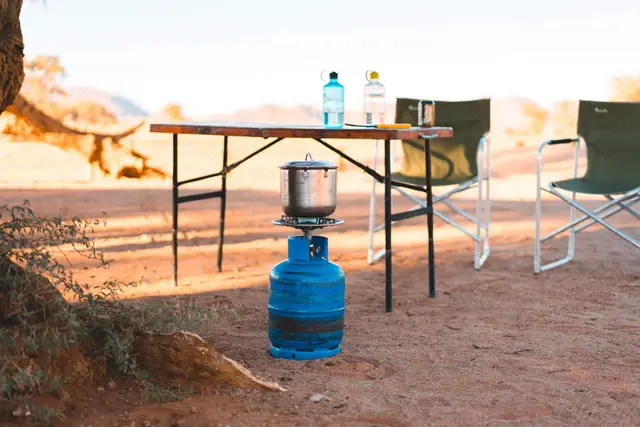

If the light isn’t that important to you, there’s another reason why staying overnight in the park is a good idea. If you travel to Namibia in summer (so in our winter), it gets pretty hot in the desert very quickly. Deadvlei lies in a valley between the dunes. The salt and clay pan heats up within minutes as soon as the sun appears over the crest of the dunes. There’s not the slightest trace of a breeze in the valley. So we recommend you set off as early as possible – ideally when the gate opens. Even if getting up early isn’t everyone’s cup of tea, you’ll thank yourself later, because you’ll already feel the heat a few hours after sunrise.
The way to Deadvlei
Once you’ve decided where you want to stay the night, it’s time for something we’d have liked to know in advance. The way to Deadvlei isn’t as easy to find as you might expect. But first things first…
If you’ve already stayed in the park or entered later through the official park entrance, you drive straight past a small control hut towards Sossusvlei. The relatively new tarmac road – now even with a central line – is the only road that leads to the famous dunes, Sossusvlei and Deadvlei. You follow the road for around 61 km to a car park at the end of the tarmac.
From this point only 4x4 vehicles are allowed, because the tarmac ends and from then on there’s only soft sand. There you should switch your vehicle from H2 via H4 down to L4 so that you’ve activated the maximum four-wheel drive level. There are always stories doing the rounds about whether or not you need to let air out of your tyres. Our Toyota Hilux had a general tyre pressure of 1.8 bar at the front and 2.0 bar at the back. Our rental company gave us the tip to simply switch to full four-wheel drive and then the vehicle would easily work its way through the sand with this tyre pressure – the important thing is to drive at about 30 km/h so the vehicle doesn’t get stuck. Of course you can let air out of the tyres if it makes you feel safer, but it’s not really necessary. To be honest, the first time we drove through the sand we also had a queasy feeling. But after we’d successfully driven through the sand for the fourth time, we can now pass on our rental company’s recommendation with a clear conscience. Oh yes: it’s about 4 km through the soft sand – quite a distance, but definitely manageable.
Once you’ve mastered the exciting part of driving through the soft sand, you reach the Deadvlei car park. There you’ll find a sign that tells you to simply follow the markers. Seriously: all we can see is sand, sand and more sand. There’s no sign of any markers. Maybe we were just too daft, you should never rule that out. Basically it was actually just straight ahead, but all you see is sand and dunes and you really don’t want to get lost in the desert in those temperatures. So we cheated and took a look at Google Maps. Fortunately we had an offline map with us. The route is then clear and we find it quickly. Our tip: take a look at it beforehand, before you’re standing in the giant sandpit with everything around you looking the same. If you’re there later in the day of course, you’ll see footprints – but we were the first.
The most beautiful photo in the fog
So we whizz off towards Deadvlei. The light is so beautiful because the entire desert is shrouded in dense fog. The air is so damp that Laura’s hair is completely wet. When I touch my beard, my hand is soaking wet too. It’s so impressive when you’re actually standing in the dry desert, where hardly any life seems possible. We could even watch how the fog condensed on the plants, presumably giving them the water they need as survival experts. Large animals also find water in the plants’ leaves, and beetles drink the drops of dew. Fascinating.
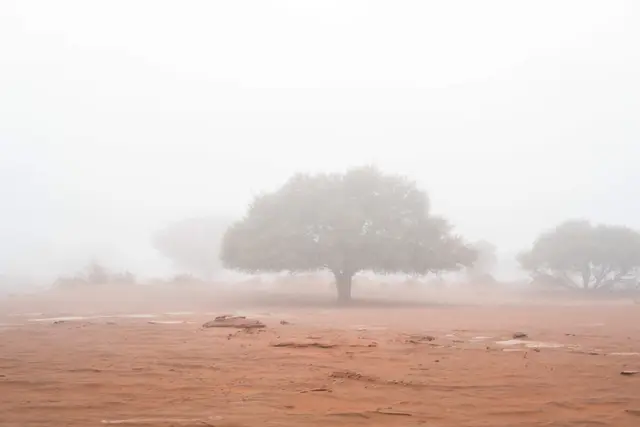
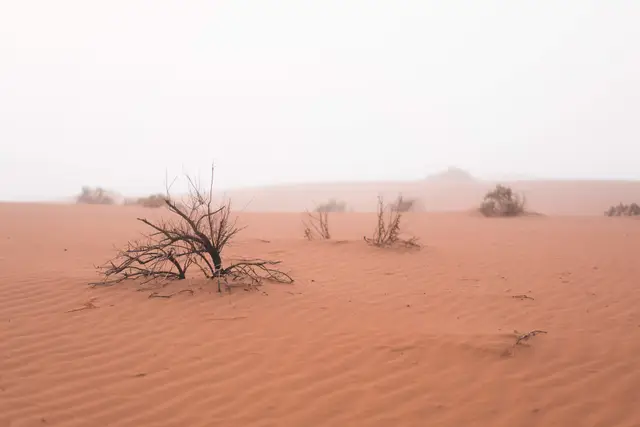


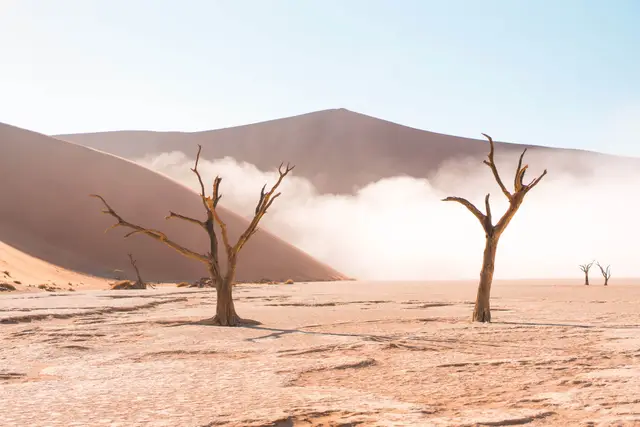
After around 170 metres through the dunes we arrive at Deadvlei. Here too we witness a special spectacle. The fog is so thick that it looks as if a white blind has been pulled down in front of the red dunes. The dead camel thorn trees of Deadvlei form a strong contrast to the white background. Especially when the sun shines over the crest of the dune and a truly black-and-white image appears before your eyes. The knobbly tree trunk in black and the fog in perfect white.
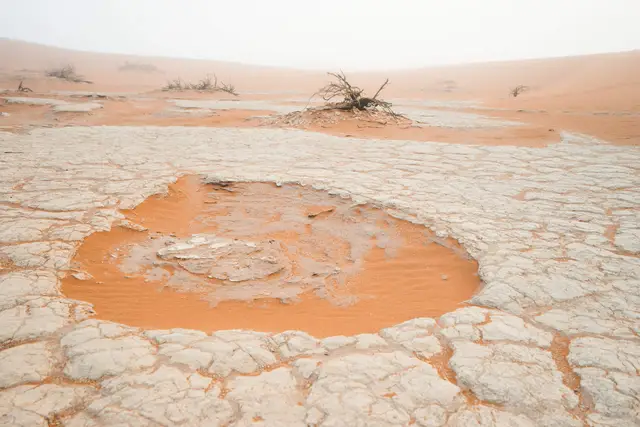
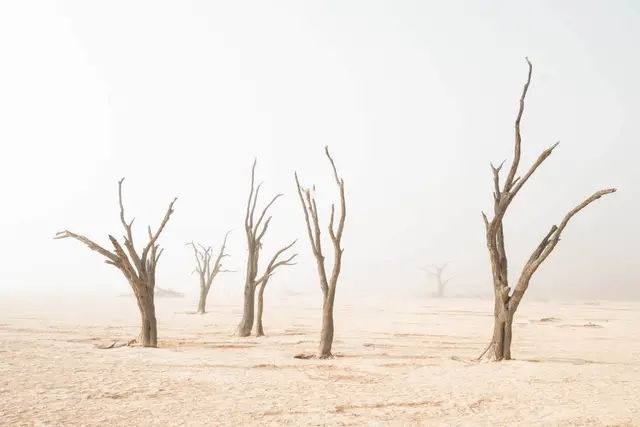
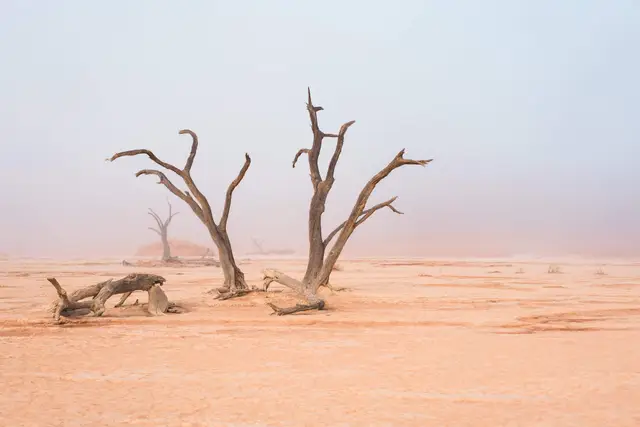
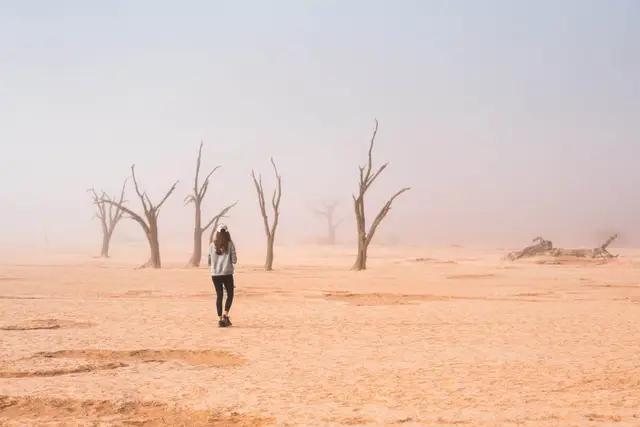
We manage to take a few photos and are pleased about the natural protection the fog offers from the sun. But the fog doesn’t last long…
Deadvlei in the early morning
The fog noticeably thins out. Now it looks as if a few clouds have become trapped in the valley. Again it’s an impressive spectacle that doesn’t look like a desert at all and doesn’t live up to the name Deadvlei either. A few photos later, the fog disappears completely.
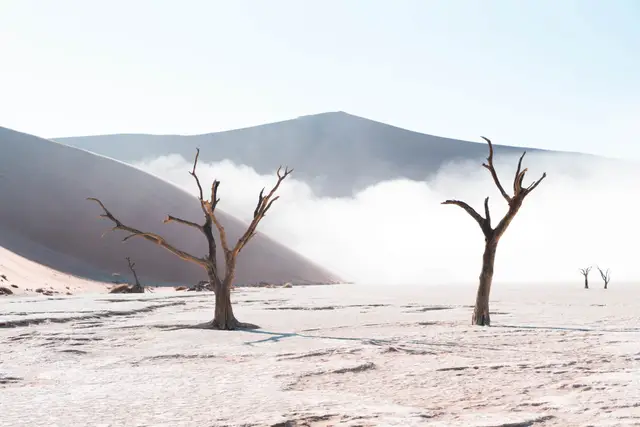
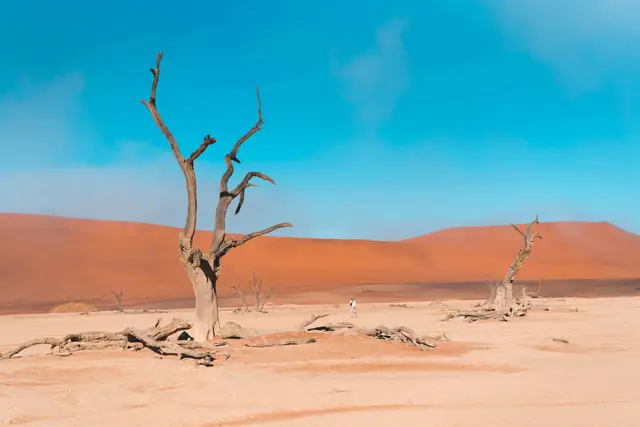
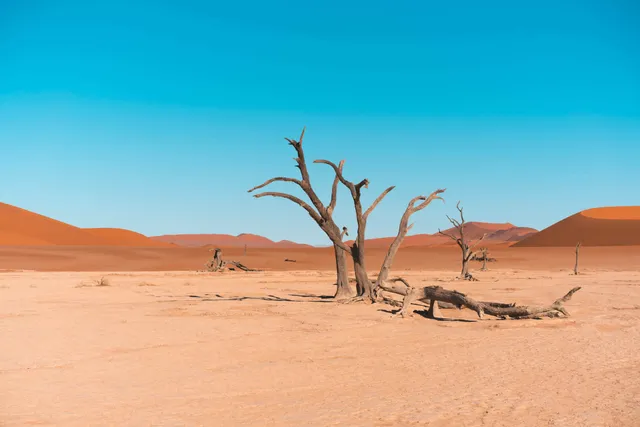
You can now see the preserved camel thorn trees against the backdrop of the red dunes. An incredible contrast. While the ground is made up of a white salt and clay pan, you see the red sand of the dunes in the background and above that the bright blue sky. The contrast between the blue and the red of the dunes gives the whole scene an amazingly unnatural feel that somehow seems totally surreal. Because of the many years of intense sunshine, the camel thorn trees – or what’s left of them – have already faded quite a lot. That makes everything seem even more unnatural.
We slowly notice that the valley is getting busier too. Apparently quite a few people have also watched the sunrise at Dune 45 before setting off towards Deadvlei.
It’s slowly getting hot in Deadvlei
While noticeably more people now arrive at Deadvlei and want to take photos, we realise it’s getting warmer by the minute. It’s now 10am and the sun is already quite high. The trees’ shadows become harder, the light bluer and the magic of Deadvlei turns into the typical guidebook image of Deadvlei: camel thorn trees in front of the red dunes with a hard shadow from the sun.
We slowly decide to start making our way back. Even though it is only around 170 metres, it still takes a while to get back to the car park over the dunes. A few more people come towards us who are now setting off in the direction of Deadvlei. Back at the car we realise that it really was a good idea to plan two nights in Sesriem. In summer it just gets too hot in the afternoon to wander through the dunes. The morning until 10 or 11am is ideal and manageable. Only one thing is clear: at that time of day you simply cannot be everywhere at once. There is so much to discover. Time flies and the sun beats down ever more mercilessly from above. If you travel to Namibia during the German winter, plan enough time in the morning so that you can really enjoy all the impressions.
Planifie ton voyage dans l’app.
Enregistre activités et hébergements, compose ton itinéraire et emporte tout hors ligne.