Cette page n’existe pas encore en français : nous te montrons la version disponible.
The secret life of orcas

Par Laura & Tobi ·
Orcas are clever hunters and at the same time highly social beings. Why one orca is not the same as another is what you’ll find out here.
The region around Vancouver Island is the best place in the world to watch orcas in the wild. In the Pacific off the Canadian coast there are even three different types. The exciting thing is that these so-called ecotypes live side by side. They neither have contact with one another nor share a menu. Did you know that?
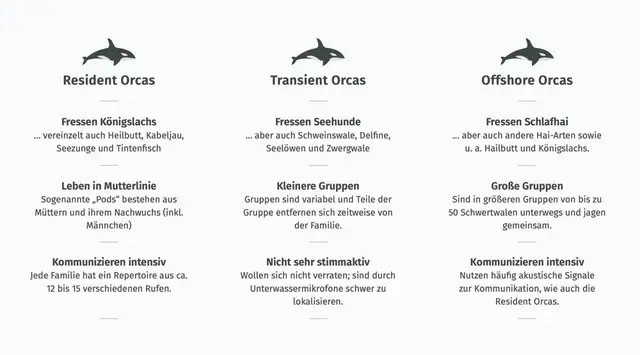
One ecotype is the so-called offshore orcas which, as the name suggests, live far out in the Pacific and are therefore rarely seen. That is probably also why not much is yet known about this ecotype. So far, however, we do know that offshore orcas eat fish as well as mammals and even sharks.
Then there are the transients. Here too the name says a lot about this ecotype, as they travel along the Pacific coast, always in search of food. They hunt mainly mammals including harbour seals, sea lions and other whale species.
Last but not least, you can also watch the resident orcas here. As they follow the salmon shoals, they like to come into the waters off Vancouver Island in summer. That is when they hunt the particularly fatty chinook salmon. Compared to the other two ecotypes, they are exclusively specialised in salmon as their food.
The resident orcas off Vancouver Island
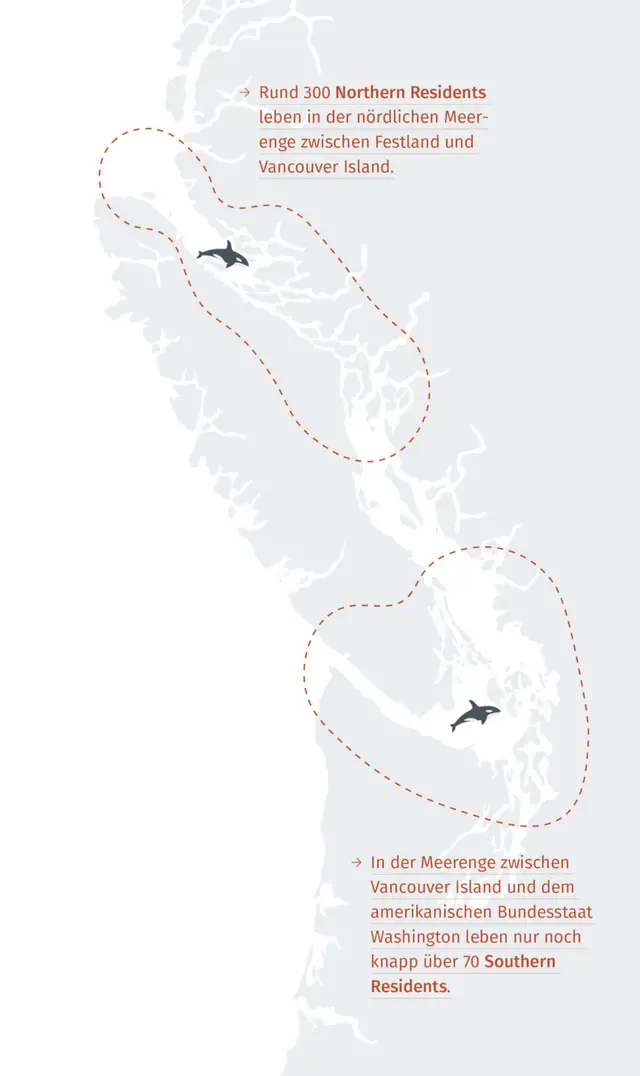
If you spot an orca in the waters off Vancouver Island, it is very likely to be a resident orca – more precisely a northern or southern resident.
The roughly 300 northern resident orcas are mainly found in the northern strait between the mainland and Vancouver Island. That is where they spend their summer. To this day it is not entirely clear where they spend the winter, though they have already been sighted off Alaska.
The much smaller population of southern residents (around 74 animals) can, with a bit of luck, be seen in the waters south of Vancouver Island. Their hunting ground is the strait between Vancouver Island and the US state of Washington. In winter the whales travel as far as the waters off California and Haida Gwaii, an island in the north of British Columbia.
Orcas live in social family groups
Do you also dream of seeing an orca in its natural habitat one day? Then you are just like many other people. Whales have a special attraction for us humans. It is probably because they are on the one hand clever hunters but on the other also very social beings. Their family groups are very close-knit and resemble those of us humans.
The social behaviour of the resident orcas is the best researched of the three ecotypes. They live in so-called matrilines, have different rituals and the individual groups their own dialects.
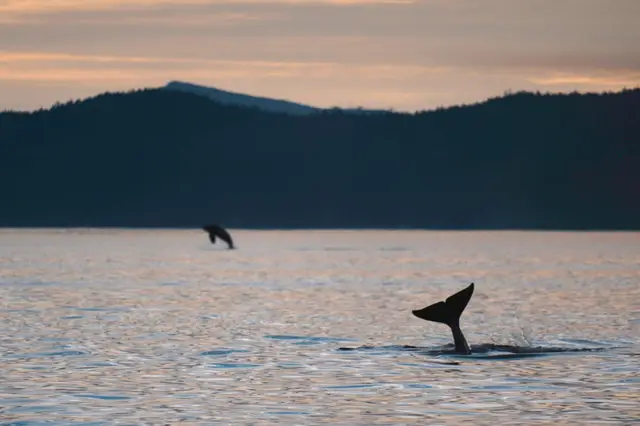
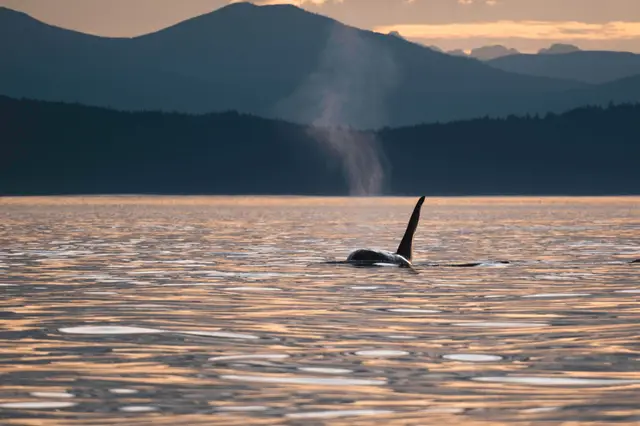
Maybe you have already seen pictures of a large group of orcas on the move. These family groups are very strong and are led by the mother. All sons and daughters, as well as their offspring, join this group. So sometimes four or more generations can live together. A group like this can become correspondingly large.
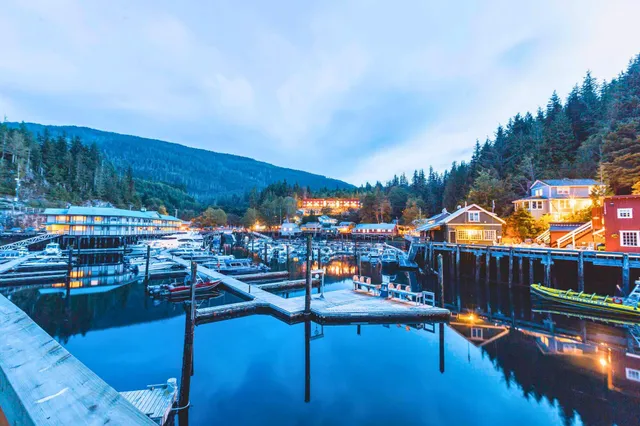
Like us humans, these groups also have their own rituals. The northern residents for example have a very special habit that has not been observed in other orcas. They deliberately seek out pebble beaches to rub themselves on the smooth stones. As they do so, they let air escape from their lungs so that they sink slowly. These so-called “rubbing beaches” are found in the Johnstone Strait, a strait off Telegraph Cove. And you know what? The orcas get really excited when they approach a rubbing beach.
And there is one more thing we have in common with them: dialects. The closer the relationship, the more dialects there are among orcas. These sounds are unmistakable and can be heard for kilometres. A calf learns the dialects from its mother and other family members, by the way. And just as we sometimes find it difficult to understand another dialect, the same is true for orcas. Every pod, meaning a group within a matriline, has a unique repertoire of sounds that other orcas cannot, or can only with difficulty, understand.
The incredible story of Springer
Now you already have quite a good insight into the life of orcas and are probably even more enthusiastic about these incredible animals. But let us tell you one more truly moving story – that of Springer.
The young orca girl “Springer” was found in 2002 about 400 km away from her family. She was only two years old at the time. This was unusual, because calves at this age are normally not left alone by their mothers. Springer, however, was wandering alone in the waters off Seattle. You are probably wondering why she did not simply make contact with the orcas in the area. The answer is as simple as it is sad: no orca in this region spoke her dialect. So Springer regularly made contact with boats. Over time it became clear that her mother had died.
Springer was then caught by a government research station and subsequently nursed back to health by biologists and volunteers in a sea pen off Washington. Fortunately, people were already aware of the dialects of orcas. With the help of underwater microphones, the sounds could clearly be assigned to individual groups. This revealed that Springer had to belong to the northern residents.
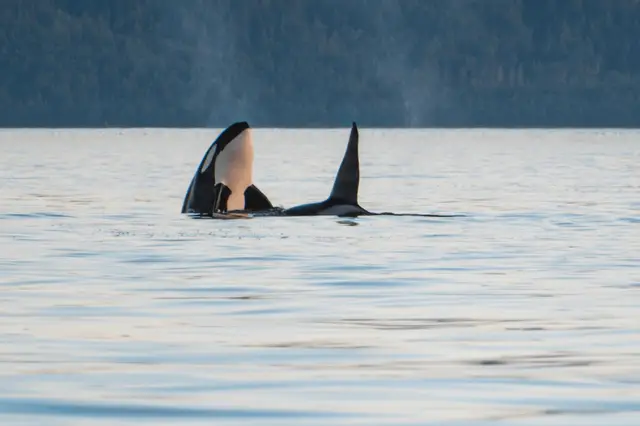
Springer was then brought to the Johnstone Strait, in the hope that she would find her family again. The outcome was uncertain. Would Springer’s family find her and then take her back in?
Springer was placed in a sea pen in the Johnstone Strait, where she made her presence loudly known. Luck seemed to be on Springer’s side. Already the next day family members came by to greet her. She was released from the pen and cautiously joined the pod.
The release was a real success: in the weeks that followed, Springer was repeatedly seen with her family. Today Springer already has a family of her own. Her calves “Spirit” (born 2013) and “Storm” (born 2017) have been by her side ever since.
See for yourself
Isn’t that an incredible story? It once again shows how fascinating orcas are. If you now really want to watch wild orcas, then the north of Vancouver Island is the ideal place to do so. Compared to the southern residents, the northern residents living here are much more stable in their population.
The best time to see orcas in the north of Vancouver Island is between mid July and October. You can watch them from a kayak, on a boat tour or even directly from the beach. Selected operators who follow the rules of respectful whale watching can be found under the respective activities.
Crédits photo : Alle Fotos in dieser Wildlife Story stammen von Sinead, die als Guide in einem Orca Camp in der Johnstone Strait Reisenden unglaubliche Momente beschert hat., Titel: Alice Donovan Rouse
Pour aller plus loin
Planifie ton voyage dans l’app.
Enregistre activités et hébergements, compose ton itinéraire et emporte tout hors ligne.